 Retro Replay Retro Gaming History, Reviews & Emulation
Retro Replay Review
Gameplay
Furcadia starts with an unusually personal kind of character creation. Picking a species, gender, colour palette, and a short description does not sound like much on paper, but it immediately frames your avatar as someone entering a shared role-playing space rather than a hero being pushed down a fixed path. You are free to socialize and inhabit the Dragonlands in your own way, which can be refreshing when you want a game that does not constantly demand the next objective.
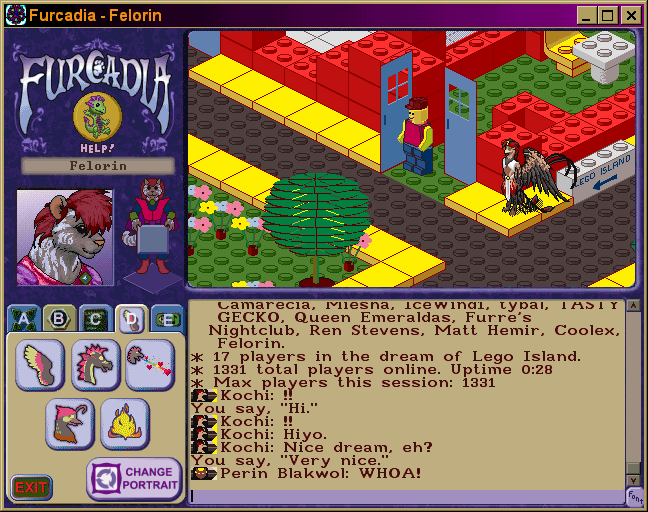
The real hook is the Dream system. Instead of merely visiting developer-made zones, you can enter player-created worlds or make one yourself. The included art editor, map creator, and DragonSpeak script editor turn Furcadia into a social game with a creative workshop attached. A Dream can be an original fantasy space or draw on mythology, films, or television, so the range of ideas is naturally broader than a single setting could offer.
DragonSpeak is where a basic map can become a place with actions and responses. Its ability to handle simple or complex behavior gives builders room to grow, while sound files can add another layer when a Dream is uploaded. That freedom is also Furcadia’s dividing line: you need to enjoy self-directed exploration, role-play, or tinkering. If your ideal RPG supplies a tightly paced campaign and clear mechanical advancement, you may find the openness more aimless than liberating.
Digos add graphical and functional enhancements, purchased with Dragon Scales, and support the game’s development. They fit the broader culture of personal expression and creation, though the central experience remains meeting people and seeing what they have made. Content ratings for Dreams are a sensible practical touch, letting younger users avoid adult-rated spaces; portable versions do not permit adult content.
Graphics
Furcadia uses an isometric view for its fantasy spaces, with furry avatars distinguished by the species, gender, and colour choices you make at creation. The most interesting visual aspect is variety: each Dream can use its creator’s own art, so moving between worlds can mean moving between very different looks rather than seeing one fixed set of locations.
Story
There is no single authored plot carrying you from one major moment to the next. The Dragonlands are the shared fantasy backdrop, but Furcadia’s stories come from role-playing, conversations, and the Dreams people build. That makes it closer to a stage full of user-made sets than a conventional RPG campaign.
This is a strength when you arrive with friends, enjoy improvising a character, or like discovering themed worlds shaped around fantasy, mythology, movies, or television. A well-made Dream can give a visit its own sense of place simply because someone chose what belongs there and how it should react to you.
The trade-off is straightforward: the game cannot supply one universal narrative payoff because it is built around many separate spaces and communities. You bring some of the momentum yourself. For a gamer who wants to write, act out, or stumble into small shared stories, that is exactly the reason to play; for someone craving a carefully plotted tale, it is a poor match.
Overall Experience
Furcadia is a distinct kind of online RPG: part fantasy social space, part role-playing venue, and part creation suite. Its age is not the important thing here; its unusual commitment to letting users build Dreams is. Plenty of games let you customize a character, but fewer put map-making, art editing, scripting, and sound-supported world creation so close to the social experience.
Give it a chance if the thought of wandering into player-made worlds sounds more exciting than following a quest marker. The best use of Furcadia is active rather than passive: make an avatar with a personality, visit a few Dreams, and consider building something small once the tools start to make sense. Its reward is a sense that the world can belong to its community, not just to its creators.
Skip it if you need combat, structured progression, or a definitive ending to justify your time. Furcadia asks you to make your own reasons to stay, and that can be frustrating when a social space feels quiet or a Dream does not suit your tastes. But for creative, social-minded fantasy fans, its mix of role-play and user authorship remains genuinely compelling.


Reviews
There are no reviews yet.