 Retro Replay Retro Gaming History, Reviews & Emulation


Retro Replay Review
Gameplay
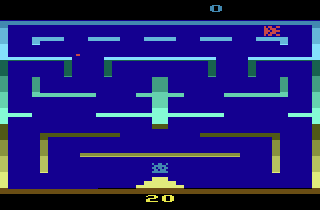
The central idea lands quickly: phantom tanks appear and disappear, and you must destroy twenty of them to clear a level. That makes every moment about watching the battlefield and reacting before a newly visible enemy gets a clean line on either you or the outpost. There is no long warm-up. You begin defending immediately, which suits an arcade game built around repeated pressure.
Level one is the most inviting of the three because its wall maze gives you room to maneuver and a way to slow the enemy down. You can use that terrain to make the battle feel less chaotic, and it teaches the core rhythm before the game starts taking safety away. Clearing all twenty tanks feels like a genuine checkpoint because it asks for sustained awareness, not just a brief lucky run.
Then the protection shrinks to a small island in level two and disappears entirely in level three. That is a clean escalation, but also where frustration can set in: the game strips away options instead of introducing a wider range of situations. With only five tanks per level, mistakes matter sharply. If you enjoy mastering a compact challenge through repetition, that severity is the point; if you need variety to stay engaged, the loop may wear thin fast.

Graphics
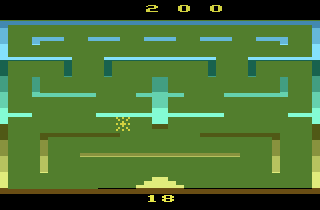
The fixed top-down battlefields are easy to parse: your tank, the base, enemy tanks, and whatever cover remains all share a compact screen. The wall maze of the first level gives the action its most distinct look, while the later island and open-field layouts make the battlefield feel visibly barer as the defense grows more desperate.
Story
The story is bare-bones but appropriately direct. You are defending the last free outpost, and its destruction means doom for the free world. That gives the base more importance than a generic target: protecting it is the whole mission, not a side objective.
There is no need for elaborate plotting here. The conflict is communicated through the match conditions themselves—your lone tank, the threatened outpost, and repeated waves of phantom attackers. Each cleared set of twenty reads as another successful holdout.
The stronger storytelling touch is the progression from fortified maze to island to no cover at all. Even without extra narrative detail, the changing battlefields make the situation feel increasingly bleak. It is simple arcade fiction, but it matches the escalating challenge neatly.
Overall Experience
Tanks But No Tanks is a focused survival shooter rather than a sprawling tank game. Its best moments come when a phantom tank reappears in an inconvenient spot and you have to decide whether to pursue it or stay near the outpost. The rules are uncomplicated, yet the disappearing enemies stop the defense from becoming entirely routine.
The downside is that the game has very little slack. Three levels, a fixed requirement of twenty enemies per level, and dwindling terrain create a concise challenge, but not much room for surprise beyond that escalation. The final open confrontation is a fitting payoff if you have bought into the premise; it can also feel more exhausting than triumphant if the earlier repetition has already lost you.
Give it a chance if you like Atari-era shooters that ask you to learn one tight arena under pressure and accept failure as part of the contest. It is less suited to a relaxed session or anyone looking for a deep campaign. As a compact, unforgiving test of defensive nerve, though, it has a clear identity and enough tension to justify a few determined retries.


Reviews
There are no reviews yet.