 Retro Replay Retro Gaming History, Reviews & Emulation


Retro Replay Review
Gameplay
The first few minutes have the immediate pull an arena shooter needs. You have one ship, one life, a screen full of incoming trouble, and a score that makes every close escape feel valuable. Keyboard movement paired with mouse aiming lets you focus on threading through danger while firing wherever the pressure is worst, which is exactly the right kind of split attention for this format.
The seed system is the reason to stick around after the basic loop is clear. Before each game, you enter a word that influences the ship, bullets, enemies, enemy behaviour, and bonuses. Rather than merely asking whether you can survive another wave, it asks you to learn what kind of run this particular word has handed you. That variability gives experimentation real weight: a seed can become a challenge you want to revisit, not just a random reset.
Power-ups add welcome moments of relief, but they also create risk. Bombs, shields, time stretch, faster firing, and multiple bullets must be collected before they disappear, so reaching for one can put you in a worse position. Starting with a bomb gives you one emergency answer, while score multipliers reward you for maintaining momentum. Frustration will set in if you want steady progression or a forgiving learning curve; one life and endless waves leave little room to recover from a bad decision.

Graphics
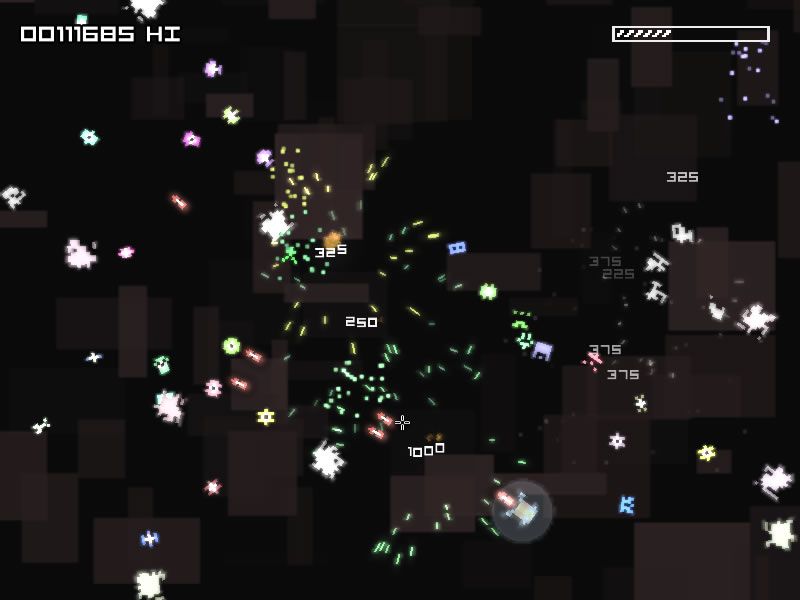
The action is viewed from above on a single battlefield, keeping the ship and the surrounding enemy swarm in the same compact space. Multiple backgrounds can be selected, and the procedurally generated ships, bullets, and enemies mean a new seed can change what you are looking at as well as how the run behaves.
Story
There is no authored campaign pulling you from match to match. The story here is the tiny survival tale you make for yourself: the moment a crowded screen forces an escape, the disappearing bonus you gamble on, and the run that ends just before a new multiplier could matter.
The seed word gives each attempt a loose sense of identity. You are not uncovering plot, but you are entering a distinct version of the arena whose enemies and weapons behave differently. For a score-chasing game, that is a better fit than a thin narrative wrapper would have been.
If you need characters, lore, or a final narrative payoff, Invaders: Corruption has nothing to offer you in that direction. Its tension comes from personal history with a run: which seed beat you, how far you got, and whether you can make the next attempt last longer.
Overall Experience
Invaders: Corruption is a focused arcade game that understands the value of a short, dangerous run. The core is familiar—move, aim, shoot, survive—but the seed-driven variation keeps it from feeling like the same board with a new score attached. When the combination of your ship, bullets, and enemies clicks, you get the satisfying sense that improvement means adapting rather than simply repeating a memorized route.
Its limits are also part of the deal. This is built around high scores, endless waves, and leaderboard submission, not around a long-form escalation toward credits. A brutal seed or an early death can feel abrupt, especially when a power-up vanishes just out of reach, but that sharpness is what gives a good run its charge.
Give it a chance if you like the immediate pressure of games in the Geometry Wars mold and want randomness that changes more than enemy placement. You should skip it if you need a campaign, a safety net, or a reason to play beyond beating your own score. For everyone else, the seed entry is a small but effective invitation to see what strange fight your next word creates.

Reviews
There are no reviews yet.