 Retro Replay Retro Gaming History, Reviews & Emulation

Retro Replay Review
Gameplay
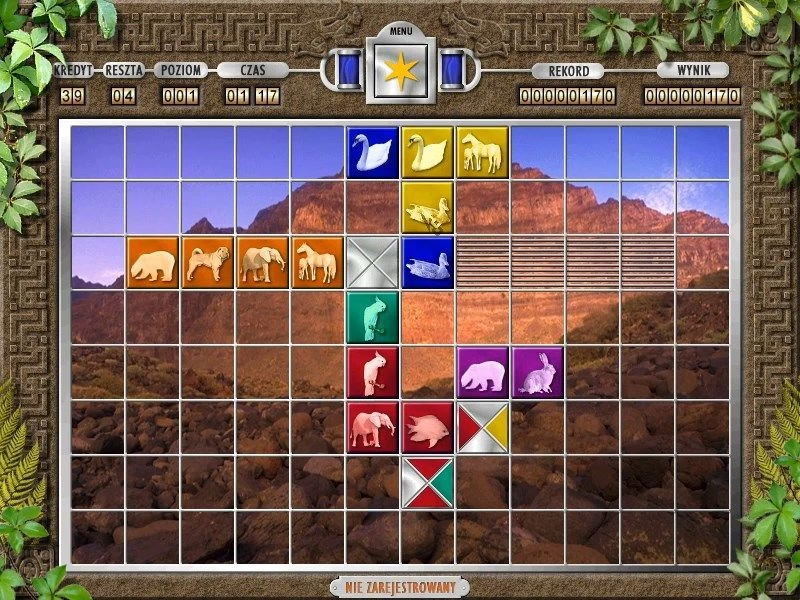
At first, Passage 3 seems like a straightforward matching game: place tiles so neighboring pieces share either a color or an image, then complete horizontal or vertical passages. Give it a few turns, though, and it becomes a tight spatial puzzle about leaving yourself options. A tile that neatly extends one chain can seal off the exact space you needed for another. You are constantly weighing the immediate satisfaction of a match against the shape of the board you will have to live with afterward.
The fixed 8-by-12 playfield is large enough to support real planning without becoming hard to parse. Construct asks you to fill specified spaces, Clear asks you to remove marked tiles through passages, and Classic makes placing all 72 tiles the challenge. Continue is the most naturally replayable variation, since its endless tile stream turns good planning into a test of endurance. These modes do more than rename the same task: each one emphasizes a different kind of board-reading.
Special tiles give you just enough room to recover from an ugly setup. Gray tiles loosen adjacency requirements, while star tiles can remove one, two, or three neighboring tiles. They are valuable pressure valves, not excuses to stop thinking ahead. The catch is the credit system. Invalid placements and careless skips cost credits, and losing them all ends the run. That makes the tutorial guidance helpful, but it also means the game can feel punitive when you misread a crowded position.
Difficulty settings sensibly change the rhythm. Easy drops the timer and starts you with 40 credits, making it the best place to learn how passages interact. Medium rewards quicker solutions, while Hard gives you 20 credits and only six seconds for each tile. Hard is for players who already see several possible placements at a glance. If you prefer puzzles that let you quietly ponder every move, stay with Easy or accept that the tougher settings are designed to make you sweat.

Graphics
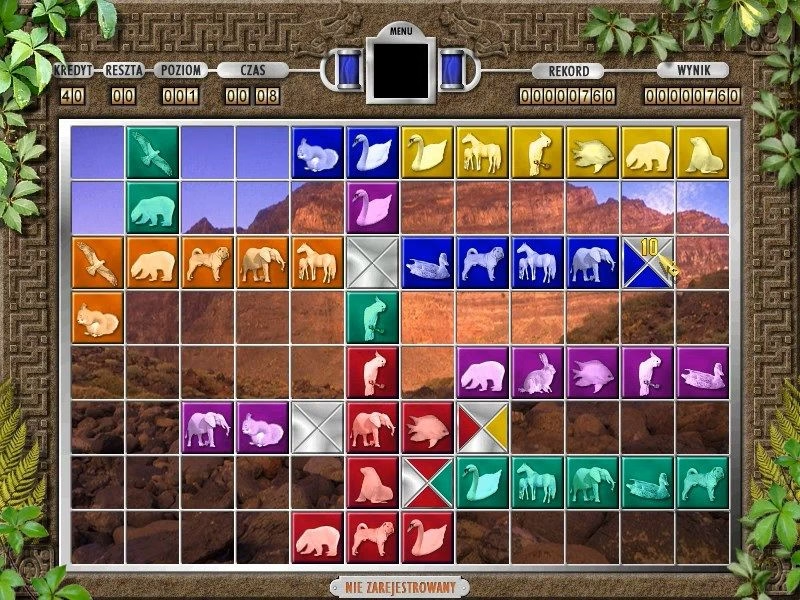
The board is easy on the eyes in a distinctly early-2000s PC-game way. Bright square tiles carry clear animal silhouettes, including elephants, rabbits, swans, horses, and fish, in bold blues, yellows, reds, greens, and purples. The images give matching by picture a more immediate feel than plain symbols would.
Behind the grid, a warm mountain landscape peeks through open spaces, while stonework and leafy jungle plants frame the play area. It is a busy border, but the colorful tiles remain the focus. Gray and star pieces stand apart cleanly, so the special tiles do not get lost among the animal sets.

Story
Passage 3 is not interested in telling a story. It is an abstract puzzle game built around tiles, patterns, and the next difficult placement.
That lack of narrative is not a problem because the board itself supplies the tension. A promising line, an awkward incoming tile, and a shrinking supply of credits create the small dramas that matter here.
If you need characters, plot turns, or a setting that develops as you play, this will feel dry. If you are happy to let a clean puzzle rule set carry the experience, the game stays focused rather than pretending to be something else.
Overall Experience
Passage 3 earns its keep through interaction between a few simple rules. Matching by color or image is easy to understand, but arranging those matches into full rows and columns produces decisions that stay interesting as the board fills. It rewards patience, foresight, and the ability to abandon a tempting move when it will create a worse problem later.
The rough edge is how sternly it treats errors. Credits disappear for wrong placements and unjustified skips, while timed play can turn careful thought into rushed clicking. That tension will energize puzzle veterans, but it may frustrate anyone who wants to experiment freely. Start on Easy, learn when to save your special tiles, and move up only after the board logic starts to feel natural.
It is not a broad, crowd-pleasing puzzle game, but it has a satisfying brainy core. Give it a chance if you enjoy grid puzzles with consequences, especially if you like finding order in a board that initially looks unsalvageable. The payoff is the moment a cramped collection of animals and colors suddenly resolves into several clean passages at once.


Reviews
There are no reviews yet.