 Retro Replay Retro Gaming History, Reviews & Emulation
Retro Replay Review
Gameplay
qrth-phyl takes Snake’s central problem, your own growing body becoming a hazard, and puts it into three-dimensional spaces. The snake travels across the outer surfaces of squares, rectangles, and parallelepipeds, then enters enclosed versions of those shapes. Each level asks you to collect a required number of dots before an exit appears, but reaching that exit is rarely as simple as following the nearest pickup. Every dot makes the body longer, and every earlier route becomes a potential collision waiting to happen.
The alternating level types keep that familiar idea from becoming too repetitive. Surface stages make the tail the main concern, especially as higher stages demand more dots. Internal stages give the snake more room to move around itself, but replace that pressure with lasers and moving hazards. Orthogonal laser pairs can cut across a route, while fixed blocks, temporary blocks, moving arrays, and columns that pass vertically through the play area force quick changes to a plan that may have looked safe a moment earlier.
The scoring system gives the survival loop real bite. Dots collected in quick succession build a combo, raising the value of each pickup while they are flashing. You can move faster to keep a chain alive, grab dots before a laser blocks the way, or race through a dangerous stretch. That speed also brings a harsher response from the game, so it is not a free advantage. The result has some of the same score-driven tension as QIX: greed is exciting, but staying out one more moment can turn a good run into a wreck.
Sequence mode is the main challenge, carrying you through an indefinite run with four lives as it alternates between outer and internal levels. Its generated hazards adapt to strong performance, meaning quick play, clean survival, and aggressive dot collection lead to tougher conditions. Elements offers a more concentrated score-attack alternative, letting you tackle level types individually with one life and endlessly appearing dots. The structure will test anyone who wants predictable difficulty, but it gives dedicated players plenty to learn and optimize.
Graphics
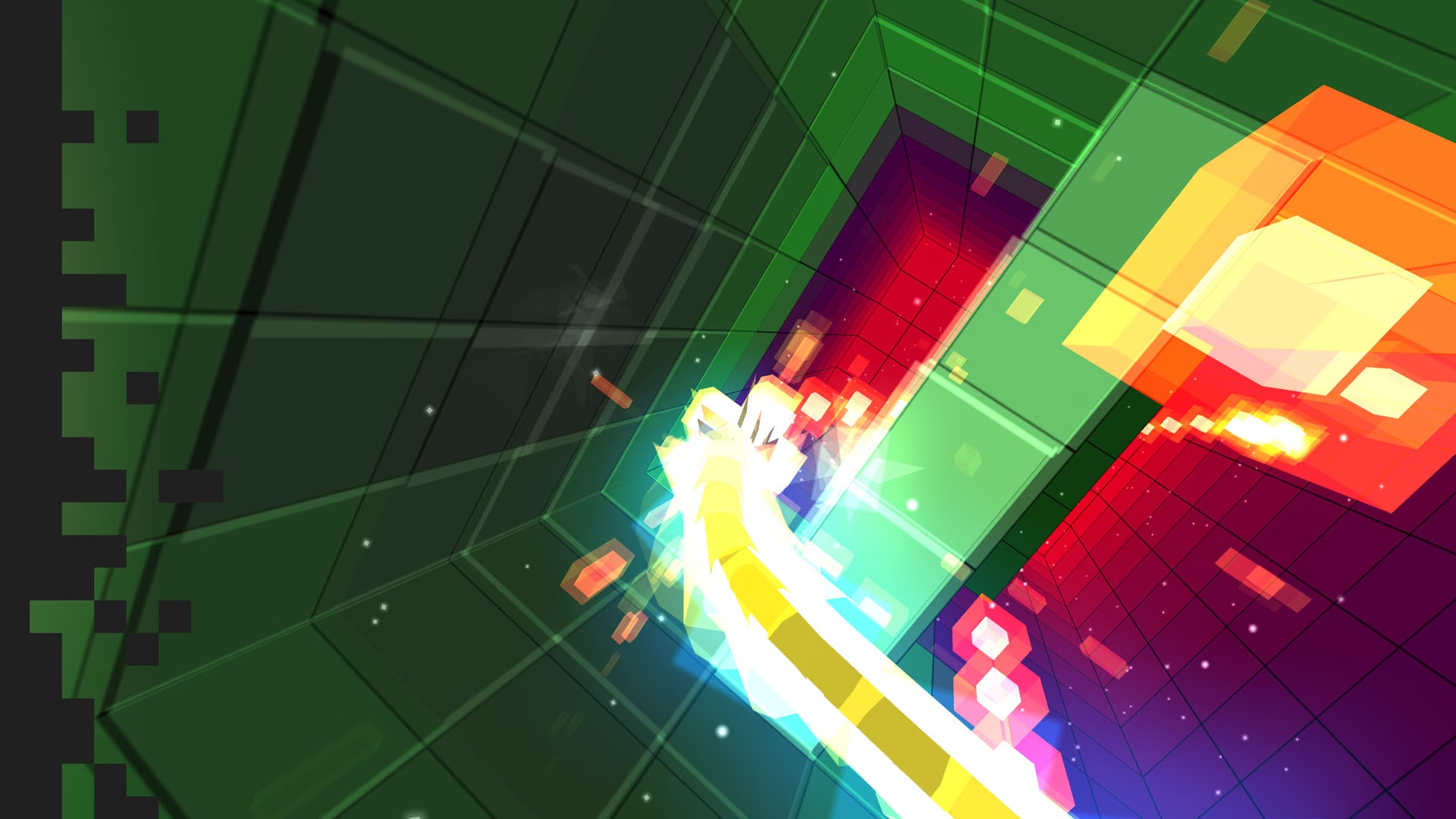
Colored geometric spaces fill the screen, with the snake crawling around boxy outer surfaces or moving through enclosed volumes. Nearby areas remain visible while distant portions disappear from view, so a stage can feel like a partially revealed space rather than a complete board laid out in front of you. That limited sightline makes the snake’s next turn feel important.
The visuals stay abstract: the threats are geometric shapes occupying the same space as the snake. Lasers cut across the level, blocks interrupt usable space, and tall columns pass through internal stages. Changing color tints and light effects give the plain shapes a psychedelic edge, while the corruption graphic at the left grows more intense the longer the snake remains alive. It is not scenery-heavy, but it suits a game that needs you to read danger quickly.
Story
qrth-phyl is not built around a conventional plot or a cast of characters. Its framing comes from survival: the snake must avoid its own body, an idea treated as a metaphor for avoiding the past. That metaphor gives the familiar rule a fitting connection to the trail the player leaves behind.
The developer also describes a documentary thread running through the game. Hidden material charts the development of Blockade, Snake, and worm games from 1976 onward. It is a fitting extra for a game that takes one of arcade gaming’s simplest ideas and pushes it into stranger territory, connecting its 3D levels to the much plainer screens that came before.
Corruption adds to that mood in two separate ways. During play, the entropy graphic intensifies as the snake stays alive, without affecting the rules. Elsewhere, an overall corruption percentage tracks how long and how well the game has been played. With no continues, failure remains final, and the growing on-screen effect makes a long survival streak feel increasingly precarious even before the next hazard appears.
Overall Experience
qrth-phyl is strongest when it makes the safe choice and the profitable choice pull in opposite directions. You can collect enough dots to reveal the exit, or stay behind to chase extra points and preserve a combo. Since dots keep appearing and the snake continues to grow, there is always a reason to push farther than common sense recommends.
The adaptive design is its best idea and its most demanding one. Playing well does not lead to a comfortable victory lap, because the game responds with greater hardship. That can feel severe when a clean run earns more trouble, but it also keeps the game from becoming a memorized routine. Its electronic sound reacts to play as well, with distortion mirroring the snake’s movement and making the whole experience feel more unstable.
This is an easy recommendation for arcade fans who enjoy score attacks, escalating pressure, and repeated attempts built around improvement rather than completion. Anyone after a guided campaign or a gentle Snake variant may find its constant demands exhausting. Stick with its odd geometry, hostile obstacles, and risky scoring, though, and qrth-phyl makes a very old formula feel genuinely nerve-racking.



Reviews
There are no reviews yet.