 Retro Replay Retro Gaming History, Reviews & Emulation

Retro Replay Review
Gameplay
Ricochet Infinity understands why brick breakers endure. You start with the simple pleasure of batting an ion sphere into a field of targets, watching gaps open, and trying to keep the return alive. Then the layouts begin asking for more care. Bricks have different properties, power-ups can swing a board in your favor, and bombs can abruptly turn a promising run into a loss. That push and pull gives the game more bite than a straightforward exercise in clearing every last block.
The recall button is the standout idea. Hold the right mouse button while the ball is flying and you can pull its path toward the paddle, bending it left or right according to the ship’s position. It does not erase the need to react, but it gives you meaningful influence over a ball that would otherwise be headed somewhere useless. Once that starts to click, you stop merely surviving rebounds and begin setting up better attacks on stubborn targets.
There is a lot here for someone who likes mastering one board at a time. More than 200 levels span two episodes, while rings feed into unlockable ships and ion spheres. The ring chase adds a reason to revisit stages beyond simply seeing the next layout. Local cooperative or head-to-head play through the second-mouse option is a welcome change of pace, and the stream of downloadable user-made levels gives the game unusual staying power for its era.
Graphics
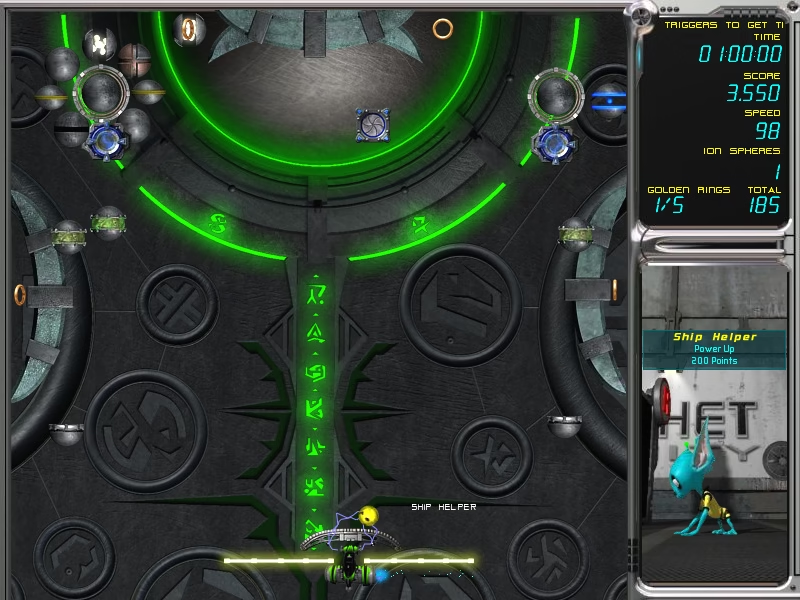
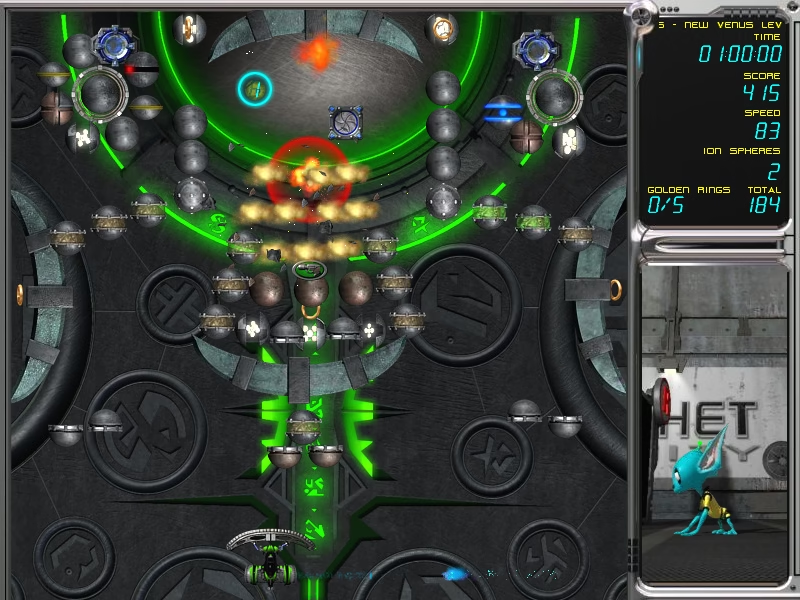
The playfields have a chunky industrial sci-fi look, built from dark metal plates, circular mechanisms, pipes, and riveted machinery. Bright neon-green rails and symbols cut through all that gray hardware, while the glowing sphere, pickups, and explosions provide sharp flashes of color. The contrast makes the ball easy to pick out even when a board is crowded.
The bottom-mounted ship and its bright horizontal paddle beam look appropriately mechanical, and the arenas have enough depth in their layered machinery to avoid feeling like flat brick grids. Some of the texture work is busy and dated, but the glowing rings and hard-edged metallic layouts still give Infinity a distinctive arcade-machine feel.
Story
Ricochet Infinity is not trying to pull you through a big narrative. Its two episodes are a structure for a long run of increasingly demanding boards, with the sci-fi setting supplying a mechanical backdrop for the action.
The ring collection is the closest thing to a continuing thread. Gathering them unlocks more ships and ion spheres, so progress carries a small sense of accumulation instead of being only about moving to the next level.
That light framing suits the game. You are here to clear boards, protect a run, and improve your command of the ball, not to sit through plot detours between stages.

Overall Experience
This is a very good brick breaker because it respects the original formula without treating it as untouchable. The recall mechanic gives you more agency than the genre usually allows, and it turns difficult angles from pure bad luck into problems you can sometimes solve with quick judgment.
Frustration will still arrive when a bomb appears at the wrong moment or a ball slips past the paddle after a chaotic rebound. That is part of the bargain. Infinity works best when you enjoy recovering from messy situations and replaying a stage to collect every ring, rather than expecting a relaxed, consequence-free clearing session.
If you want a polished, content-heavy Arkanoid-style game with a clever way to shape the ball’s flight, Ricochet Infinity is well worth your time. The campaign is generous, the unlocks give completionists a reason to dig in, and user-made levels mean the best boards do not have to end when the built-in episodes do.



Reviews
There are no reviews yet.