 Retro Replay Retro Gaming History, Reviews & Emulation
Retro Replay Review
Gameplay
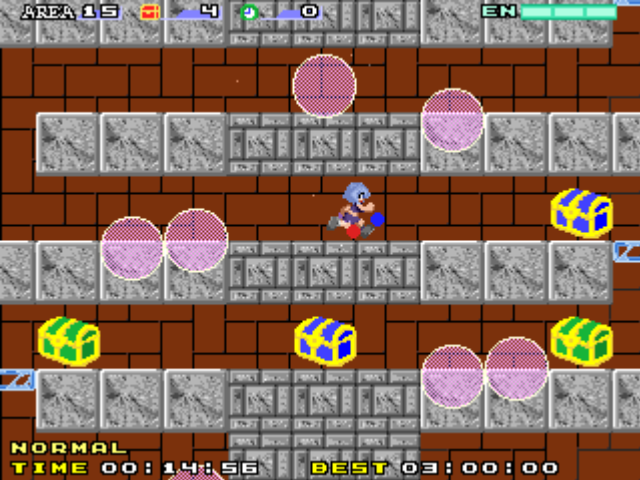
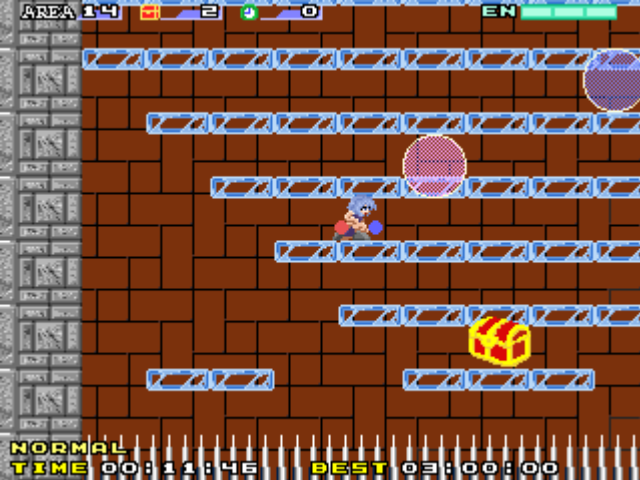
The first few moments of Search Light make its central rule wonderfully clear: stay out of the lights, collect the treasure, and get through the stage. Ira cannot fight her way past trouble, so every obstacle has to be read as a timing problem. That gives even a small side-view room a sharp sense of pressure. You are watching patrol patterns, judging a jump, and deciding whether the safe route is actually too slow or awkward to be worth taking.
The Steam Dash is the move that stops this from being a straightforward sneak-around platformer. It lets Ira cross gaps quickly, and its value grows as stages ask you to link movement decisions together. A dash can be the obvious answer to a gap, but it can also put you straight into the path of a moving light if you act too early. That tension between momentum and restraint is where the game starts to click.
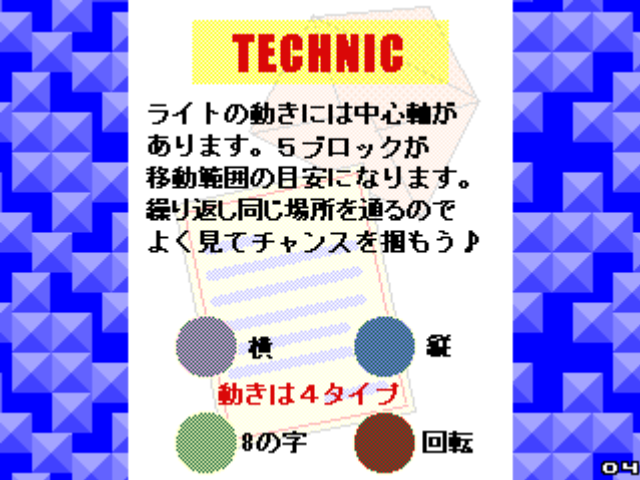
Colored searchlights move in different patterns, so you cannot rely on one rhythm for every stage. Switches further complicate the route by changing the stage layout. The result is a clean action-puzzle loop: look over the room, identify what the lights are doing, alter the layout if needed, then execute. Frustration can set in when a nearly solved route falls apart on its timing, but the quick, self-contained nature of the stages makes another attempt feel reasonable rather than punishing.
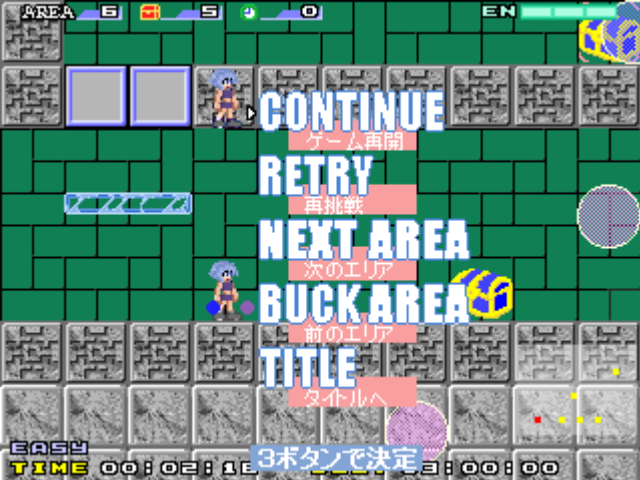
Fifty stages is a solid run for a game built around concise challenges, and free replay of cleared stages gives the better ones a second life. Best-time records and replay saves add a welcome competitive angle without getting in the way of simply finishing the game. Ranking up for extra tips and information is also a sensible nudge for anyone who hits a wall. Play it methodically at first; chase the clock after you understand why a route works.
Graphics
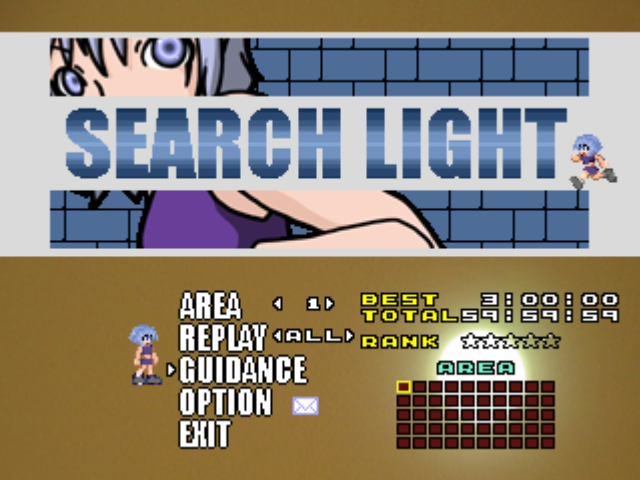
Search Light uses a side-view, anime/manga-styled look centered on Ira, the stage layouts, and the colored searchlights that define each challenge. The moving lights are the crucial visual element, since their paths are what you need to read before making a jump or dash. Keeping that threat visible matters more here than ornament, and the side-on view suits the game’s compact platform puzzles.
Story
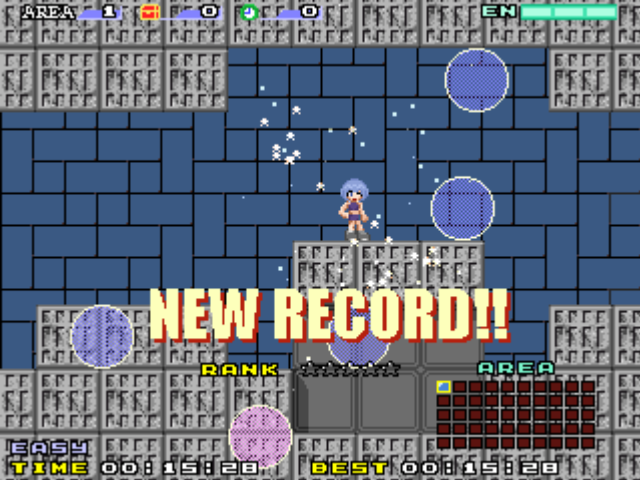
The story gives the treasure collecting a little more weight than a bare score-chase premise. Ira is pushing back against the repressive Neo Bungeling Empire, which has seized her people’s treasures, and she enters its strongholds armed with her village’s last treasure, the Steam Dash. It is a direct setup, but it fits the game’s stripped-down action well.
What works is Ira’s position in the conflict. She is not described as an overpowering hero marching in to flatten the empire; she has to sneak into hostile spaces, avoid detection, and recover what was taken. That makes the no-attack design feel thematically appropriate rather than like a random restriction.
Do not come in expecting the plot to overshadow the puzzles. The dystopian premise functions as a clear reason to keep entering new strongholds and reclaiming more treasure. For this kind of stage-based game, that is enough: the story supplies purpose, while the changing light patterns and routes do the heavier lifting.
Overall Experience
Search Light is strongest when you treat it as a compact precision-puzzle platformer instead of an action game. Its best idea is simple and consistently useful: taking away combat means that movement, observation, and nerve have to carry every success. Each clear feels like you found a safe line through a dangerous room, not like you merely outlasted an obstacle.
It will suit you if you enjoy studying short stages, restarting after a mistimed move, and gradually turning a cautious clear into a cleaner, faster one. The time records and replays are more than a bonus in that context; they give practiced runs a tangible purpose. If repeated attempts at a single screen sound tiring, the game’s central challenge may feel narrow.
Still, that narrowness is also the point. Searchlights, jumps, dashes, switches, and treasures are used to build a focused test of route choice and execution across 50 stages. It does not need a large toolset to stay engaging; it needs its one core rule to stay tense, and it does. For platform-puzzle fans, the payoff is a neatly structured series of stealthy little escapes that invite one more try.


Reviews
There are no reviews yet.