 Retro Replay Retro Gaming History, Reviews & Emulation
Retro Replay Review
Gameplay
The first hour of The Guild 2: Renaissance is all about choosing what kind of medieval operator you want to become. You pick from the established classes and professions, then start building a family’s place in a late-14th-century European town. It is an immediately attractive setup because your ambitions can point in several directions: make money through a trade, pursue influence at city hall, or simply outlast competing dynasties.
Renaissance earns its subtitle through useful breadth rather than a wholesale reinvention. Innkeepers and stonemasons expand the Craftsman choices; millers and fruit farmers give Patrons more options; Rogues gain mercenaries and jugglers; Scholars can become bankers or gravediggers. These careers, along with their related buildings, make repeat play more tempting because a new start can carry a different economic focus.
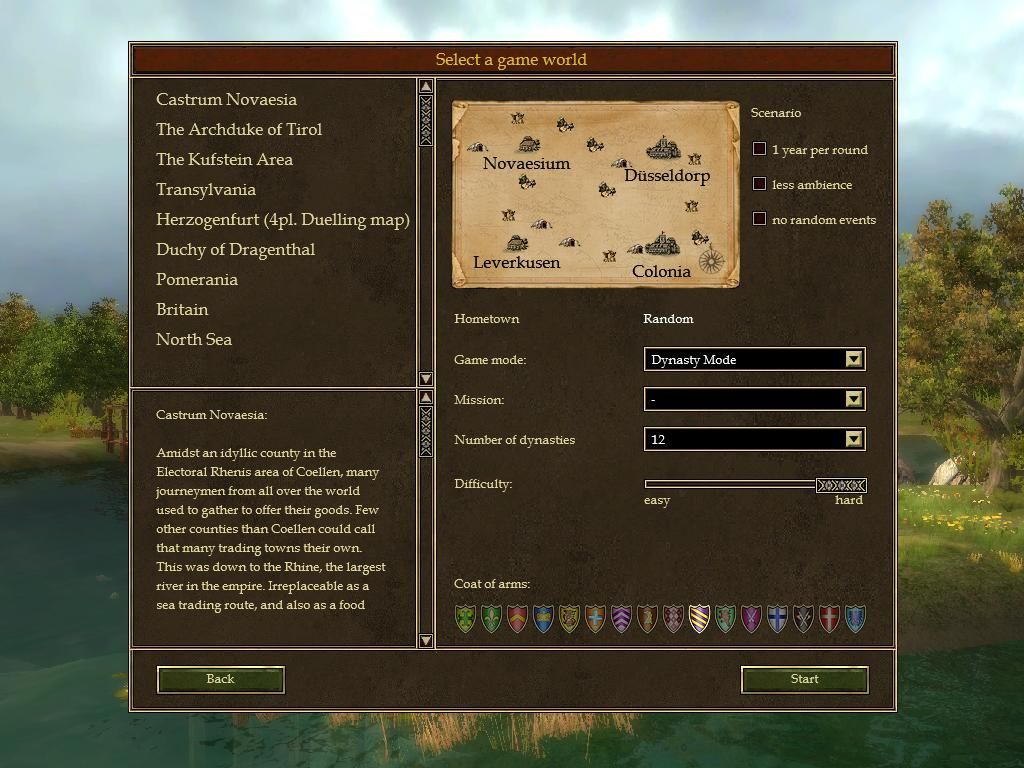
The scenario list is generous, with 18 maps spanning one to four towns and anywhere from two to 16 dynasties. A compact two-dynasty game in Transylvania should feel very different from the crowded three-town pressure of Alamannia or Lyon, Macon and Belley. Four modes—Dynasty, Time Limit, Extinction, and Mission—also let you decide whether you want an open-ended rise to prominence or sharper victory conditions.
That freedom comes with a harsh on-ramp. Renaissance has no tutorial scenario, so newcomers are dropped directly into a system that combines management, role-playing, and political maneuvering. The tougher requirements for applying to new city-hall positions add another layer of resistance to the political climb. If you enjoyed The Guild 2: Venice, the extra maps, professions, and refinements are easy to appreciate; if this is your first Guild, patience is not optional.
The optional one-year turn length is a welcome way to alter the pace from the former four-year default. It does not make the game simpler, but it gives you more control over how quickly the dynasty drama moves. That sort of adjustable pacing fits a game built around long-term planning, where a modest local enterprise can become the foundation for larger ambitions.

Graphics
Renaissance uses a top-down, third-person perspective to keep its medieval towns and their competing dynasties in view. With scenarios ranging from a single town to four-town regions, that broad view suits the game’s focus on watching a family’s influence spread across a busy map.
Story
There is no single fixed tale at the center of Renaissance. Instead, the story is the one you build around a dynasty trying to rise in late-14th-century Europe: a family starts with a profession, establishes a foothold, and reaches for greater wealth or public office.
The strongest narrative hook comes from rivalry. Every scenario is populated by competing dynasties, and a crowded setup can include as many as 16 of them. That gives your climb a personal edge even when your immediate concern is practical—expanding a business, meeting a requirement, or protecting a hard-won position.
Political advancement adds a clear sense of escalation. City-hall applications now demand more, while imperial fame and war events can complicate the wider situation. It is a story framework for players who prefer to create their own medieval family saga through consequences rather than follow a prescribed cast and plot.
Overall Experience
The Guild 2: Renaissance is appealing precisely because it is not content to be only a medieval business game or only a political strategy game. It wants you to manage a livelihood, build a dynasty, compete with other families, and chase office in the same sprawling sandbox. When those parts begin to connect, a small decision about a career can feel like the start of a much larger plan.
Its biggest weakness is accessibility. Removing the tutorial scenario is a poor fit for a game with this many overlapping concerns, and the more demanding political ladder raises the stakes without easing you into them. You need to be comfortable learning through experimentation and accepting that an early plan may not unfold cleanly.
For returning Guild players, Renaissance is a worthwhile standalone refinement: it preserves the core structure while adding professions, buildings, scenarios, action choices, and pacing options. Newcomers should only jump in if the idea of discovering a messy medieval dynasty simulator sounds more exciting than intimidating. It can be frustrating, but the payoff is a flexible, competitive campaign where your family’s rise feels earned rather than scripted.



Reviews
There are no reviews yet.