 Retro Replay Retro Replay gaming reviews, news, emulation, geek stuff and more!
Retro Replay Review
Gameplay
The first few stages ask you to unlearn the most basic platform-game instinct: you are not guiding a character with direct movement. The blue blob is perpetually bouncing, and you rotate the stage to change where that bounce will carry it. At first, that can feel like trying to correct a pinball after it has already launched. Then the rhythm starts to click. You begin reading the blob’s next landing, rotating early enough to reshape its route, and treating every surface as part of a route to the exit.
The MP bar is what stops that central trick from becoming carefree. Rotating and other actions draw from a resource that recharges slowly, so frantic corrections are a poor habit. You need to commit to a line, spend MP with purpose, and leave yourself enough room to recover when a moving platform or a hazard changes the situation. That restriction gives the game a sharper, more deliberate edge than its bouncy protagonist suggests.
Pressure comes from the HP counter as well. It is always ticking down like a timer, and enemy contact takes away a noticeable chunk, so lingering while you puzzle out a route is dangerous. Falling platforms, moving platforms, bottomless pits, and enemies make each stage a test of timing under a clock. Frustration will set in if you want room to experiment at leisure; the game wants clean decisions. But if you enjoy arcade games that reward repetition and route learning, reaching an exit after controlling a messy-looking bounce feels properly earned.
Graphics
The game is a side-view platformer built around a bright blue blob bouncing through ruin-themed stages. The rotating-stage concept should be easy to read in motion because the whole playfield shifts around a single, constantly moving character, while pits, platforms, and enemies serve as the immediate landmarks you must avoid or use.
Story
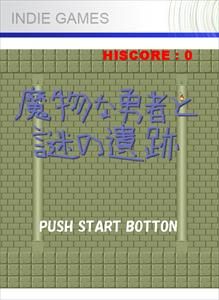
The title frames the adventure around a monster hero and mysterious ruins, and the blue blob is the clear focus of the journey. That is a light, direct setup for an action game whose energy comes from getting through stages rather than settling into long narrative detours.
The ruins give the platform challenges a simple destination: keep pushing onward through dangerous spaces toward each exit. There is a pleasing fit between that premise and the game’s unstable movement, since this is a hero who advances by surviving an environment that is always trying to knock its momentum off course.
Do not come to Mamono na Yūsha to Nazo no Iseki for a character-driven tale. Its story is mainly a playful frame for a blue monster making its way through hazardous ruins, which suits the brisk, score-chasing tension of the action.
Overall Experience
Mamono na Yūsha to Nazo no Iseki lives or dies on whether rotating the world around an automatically bouncing blob sounds intriguing to you. It is an unusual hook, and the resource limits ensure it is more than a novelty. When you start anticipating arcs instead of reacting to them, the game turns into a satisfying little discipline of timing, conservation, and nerve.
It is also knowingly unforgiving. HP drains even when you are safe, enemies punish contact hard, and a bottomless pit does not care that you nearly found the right angle. That can make the learning curve abrasive, especially for anyone expecting a relaxed platformer. The right mindset is to treat mistakes as information: learn which bounce, platform, or rotation timing broke the route, then make the next attempt cleaner.
Give it a chance if you like compact arcade platformers with one strong, demanding idea at their center. The payoff is not in broad exploration or direct character control; it is in finally making a bouncing creature follow a route that looked impossible seconds earlier. For patient players, that peculiar mastery is enough to make the ruins worth entering.


Reviews
There are no reviews yet.