 Retro Replay Retro Gaming History, Reviews & Emulation
Retro Replay Review
Gameplay
Shopping Crazy starts from one of puzzle gaming’s most dependable frustrations: the exit is right there, but a pile of awkwardly shaped stuff has turned the room into a traffic jam. Your task is to slide those items around, make space for the next move, and eventually clear a complete path so a Smith family member can leave the store. It is immediately legible, which is exactly what this sort of game needs. You can look at a blocked route and begin experimenting without a long rules lesson getting in the way.
The interesting part is not merely moving an obstacle out of the way; it is realizing that the obvious move often blocks the space you need later. Different item sizes and shapes turn each board into a little packing problem. When a route finally appears, the payoff is pleasantly tangible: all that clutter has been rearranged into a way home. If you like sliding puzzles because they reward patience and planning rather than reflexes, that simple loop has real staying power.
Five stores provide the game’s structure, with several stages in each and tougher puzzles as you progress. That gradual escalation matters. Early boards let you learn how much room a particular object needs, while later ones should demand more care before you commit to shifting the whole layout around. The flip side is obvious, too: if sliding-block puzzles already make you feel like you are repeatedly undoing your own work, Shopping Crazy will test your tolerance quickly. There is no escaping the fact that its enjoyment rests almost entirely on that one style of spatial puzzle.
Graphics
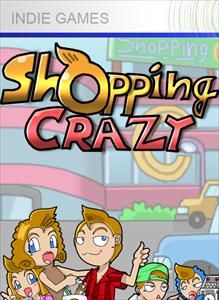
The game uses a top-down view suited to a grid-like sliding puzzle, so you can concentrate on the positions and shapes of the objects clogging each store. Its anime/manga classification also gives the stranded Smith family setup a lighter, cartoonish framing than the everyday shopping premise might suggest.
Story
The story is deliberately small: the Smith family sets out for a fun shopping day, gets separated and trapped in different stores, and needs to find a way home. It is a playful excuse for the puzzles rather than a plot that asks you to invest deeply in the family’s predicament.
Still, the setup does give the stages a little more character than a bare sequence of abstract boards. Each family member has a store to escape, and the changing store themes help frame the move from one set of puzzles to the next. You are not saving a kingdom; you are untangling a very bad day at the mall.
That modest tone works because it does not overpromise. The goal stays clear from the opening premise through every escape: create a route and get this person out. Anyone wanting a story-heavy puzzle game will find little to hold onto, but the premise is cheerful enough to make the repeated exit-chasing feel connected.
Overall Experience
Shopping Crazy is a straightforward, focused sliding-puzzle game with a friendly wrapper. Its best moments come when you stop pushing pieces around at random, spot the choke point in the layout, and suddenly understand which object has to move first. That tiny burst of clarity is the reason to play.
The increasing difficulty across the stores gives it a proper sense of progression, but it also means the game lives or dies on your affection for spatial rearrangement. You will be spending your time looking at blocked paths, protecting empty space, and trying to avoid trapping a crucial piece. For the right mood, that is calming and absorbing; in the wrong mood, it can feel like rearranging furniture in a room that is too small.
Give it a chance if you want a compact puzzle challenge with a clean objective and a lighthearted theme. Skip it if you need action, a deep narrative, or constant mechanical surprises. For sliding-puzzle fans, the familiar format and steadily harder store layouts offer a worthwhile route through this shopping disaster.


Pixel Archivist –
Shopping Crazy has a clear sliding-block loop, and the five-store structure gives the difficulty somewhere to go. The tradeoff is that there is little variety outside protecting empty space and avoiding a trapped piece, so its appeal depends heavily on enjoying that exact kind of spatial planning. The cheerful Smith family setup adds some character, but the puzzles are doing nearly all of the work.