 Retro Replay Retro Gaming History, Reviews & Emulation
Retro Replay Review
Gameplay
The first few fights in Shred Nebula are likely to make you overcorrect. You steer with the left stick, thrust with a trigger, and fire only in the direction your ship faces. Releasing thrust leaves you drifting, so victory is less about parking on target and more about lining up a pass, firing, then carrying your momentum somewhere safer. It has the feel of a small spacecraft with inertia, not a conventional stick shooter with a ship sprite attached.
That commitment is the game’s biggest strength and its biggest barrier. When the controls click, slipping through enemy fire while holding a clean firing angle feels terrific. Rechargeable shields give you room to recover from a mistake, while timed reflection, turbo, and reverse moves reward players willing to learn more than basic steering. The official flight tips are worth reading before writing the handling off, because this is one of those games that gets substantially better once you understand what it expects from you.
Adventure mode moves RIP ROCKET through more than twenty stages in search of jump coordinates, but the real point is the cycle of entering another combat space, surviving it, and gradually improving your control. That can become repetitive, especially when you want more variety than another arena encounter. Score Attack is a better fit for the design’s strengths: survival and kill chains turn disciplined movement into a satisfying personal challenge. Local split-screen supports score attack and one-on-one deathmatch, while the launch-era online deathmatch supported up to eight people. Eight multiplayer ships, each with different weapons and movement, give head-to-head matches a welcome dose of experimentation.
Graphics
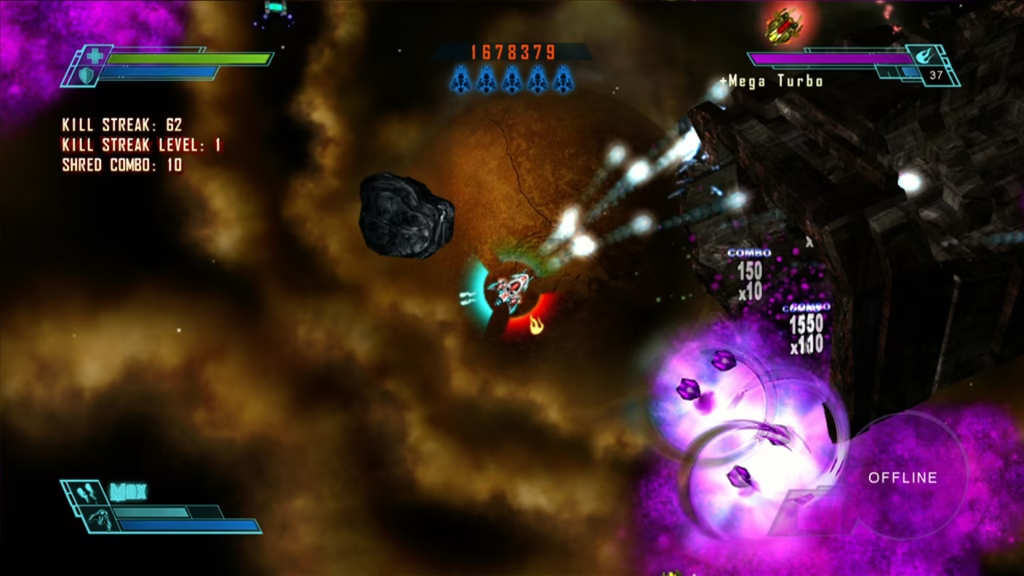
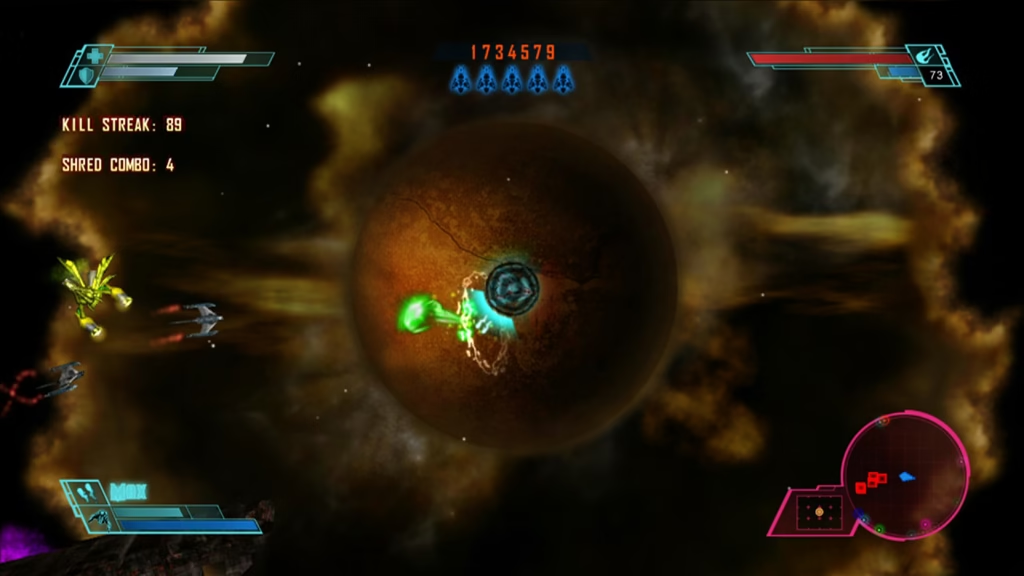
Combat takes place around striking space backdrops: a huge cracked orange planet streaked with brown clouds, dark asteroids, and bulky black structures hanging in the void. Small angular ships are easy to pick out in quieter moments, and white shot trails plus saturated purple energy bursts give the action real color against the darkness. In crowded fights, though, tiny ship silhouettes can disappear inside the bright effects near those black structures, making the busiest exchanges harder to parse.
Story
There is just enough premise here to push the ship onward. The Algron Exploration Fleet vanished twelve years ago, the rescue vessel Omega Dawn disappeared five years ago, and expeditions were banned. Dr. Gage responds by building the one-person Relentless Intergalactic Personal Rocket and sending it after the Lost Expedition.
RIP ROCKET’s search eventually brings it into contact with the Shred, but do not come looking for a character drama. The story is a light arcade frame, useful for giving the campaign a destination without getting in the way of the next fight. That suits the game well enough, although it does little to make the repeated stages feel more distinct.
The stronger narrative is the one you create through flight: the reckless first run where drift gets you cornered, the cleaner second attempt, and the run where a chain survives because you finally anticipated your momentum. Shred Nebula earns its drama from execution rather than plot.
Overall Experience
Shred Nebula is easy to admire and harder to immediately love. Its forward-fire, thrust-driven controls make it markedly different from the independent aiming of Geometry Wars: Retro Evolved 2. That difference is not a gimmick. It asks you to think about direction, speed, and defense as one connected problem, and the payoff comes when that awkwardness becomes deliberate control.
Frustration sets in when repeated arena combat starts to blur together or when a hectic effect-filled fight punishes a slight lapse in positioning. The game does not bend much toward players who only want immediate arcade comfort. Still, it has a pleasingly focused identity, and its systems reward practice with more satisfying runs rather than merely faster button presses.
Give it a chance if you enjoy score-chasing shooters that demand patience before they reveal their rhythm. The campaign is a solid proving ground, Score Attack is where the replay value really lives, and multiplayer has enough ship variation to make local competition worthwhile. For the right player, the learning curve is worth climbing. For everyone else, it may feel like a clever spaceship that never quite lets you sit comfortably in the cockpit.


Reviews
There are no reviews yet.