 Retro Replay Retro Gaming History, Reviews & Emulation
Retro Replay Review
Gameplay
Quatros Origins starts from the simple pleasure of fitting blocks together to clear horizontal lines, then immediately asks you to stop thinking in only one direction. Place a tetromino or pentomino, rotate the platform, and suddenly the piece you just used has consequences on three other playing fields. That central twist is strong because it makes familiar block-puzzle instincts useful without letting them solve everything for you.
What begins to click is the need to build with the next rotation in mind. A clean line on one side can leave an awkward shape elsewhere, while a deliberately imperfect stack may become exactly what another face needs. You are not just reacting to the current piece. You are trying to preserve options across a board that keeps changing its orientation, and that gives successful clears a satisfying sense of foresight.
That same demand is where frustration can set in. Quatros Origins can punish tunnel vision hard, especially when a piece that looks harmless from the current side complicates the whole structure after the turn. The Normal, Hardcode, Raid, and Fixate modes offer different ways to test that core idea, while local multiplayer for up to four people is a good fit for a puzzle concept that is easy to grasp and fun to compare under pressure.
If you enjoy learning a system through repeated runs, this is the kind of puzzle game that can quietly take over an evening. It is less about chasing one flashy maneuver than developing the discipline to see a few moves around the board. The Quatros Origins publisher page is useful if you want to compare its core premise with the version you plan to play.
Graphics
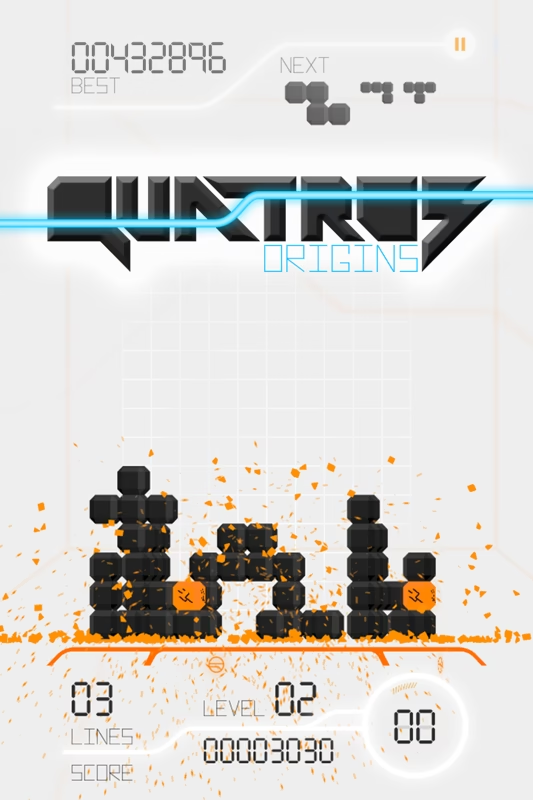
The game centers its imagery on clean, 2D-looking block layouts that become more visually interesting when the platform rotates to reveal its four active sides. The shifting view gives the otherwise familiar shapes a welcome sense of depth and makes the board change feel like part of the puzzle rather than a decorative trick.
Story
There is no narrative detour here. Quatros Origins is built around the immediate arcade question of where the next shape belongs, and that is the right call for a game whose challenge depends on quick recognition and long-term board planning.
The closest thing to a story is the one you create during a run: the early confidence of making neat lines, the creeping worry as compromises accumulate, and the recovery when a rotation reveals an opening you had planned for. That rhythm gives the game personality without slowing it down.
Anyone looking for characters, lore, or a campaign will find the focus narrow. But if you want a puzzle game to communicate through escalating spatial problems rather than dialogue, Quatros Origins stays committed to its idea.
Overall Experience
Quatros Origins earns attention by taking one of gaming’s most familiar puzzle languages and giving it a meaningful new grammar. The four-sided rotating board is not a gimmick pasted onto line clearing. It changes how you evaluate every placement, which is exactly what a good variation on a classic format should do.
The payoff is strongest once you stop treating each face as a separate board. At that point, a well-placed block can feel like a small plan unfolding across the whole platform. Before then, expect some losses that feel harsh, because the game is asking you to unlearn the comfort of solving only what sits directly in front of you.
Give it a chance if you want an arcade-style puzzle challenge that stays focused and rewards spatial awareness. Skip it if rotating a puzzle board sounds more stressful than clever. For the right player, Quatros Origins turns a straightforward line-clearing goal into a demanding little brain workout with real replay value.



Reviews
There are no reviews yet.