 Retro Replay Retro Replay gaming reviews, news, emulation, geek stuff and more!


Retro Replay Review
Gameplay
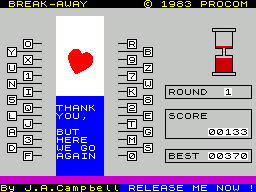
The first screen asks for a kind of concentration that sounds easy on paper and gets slippery the moment you start tracing lines. Fifteen bonds overlap, each with a letter or number at either end, and your job is to identify the correct pairs quickly enough to release the damsel. It is less about complicated rules than keeping your eyes from losing their place.
That basic task has a nicely mean wrinkle in the lookalike characters. V, W, and U can turn a confident answer into a costly hesitation, especially once several bonds cross over one another. The red HELP! interruption is harsher still: when it appears, it hides part of the puzzle and temporarily prevents you from following a bond from one end to the other. You are pushed to remember what you had already traced instead of calmly restarting your inspection.
Completion brings another screen with less time, so the game’s real challenge is building speed without letting accuracy collapse. That creates a clean arcade-puzzle loop: solve, survive the tighter limit, and chase a higher score. The session best-score tracking gives you a reason to take another crack after a failed attempt, though anyone who hates pressure timers may find the escalating pace more irritating than compelling.

Graphics
The puzzle screen is built around the overlapping bonds and their letter-and-number endpoints, with the large red HELP! block serving as the one aggressive visual interruption. Its blunt warning is easy to notice, even if its purpose is to make the board harder to read rather than prettier.

Story
There is only the thinnest rescue framing: a damsel is captive, and breaking all 15 bonds frees her. It is a straightforward excuse for the puzzle rather than a story you follow.
The damsel’s calls for help have a direct gameplay consequence through the HELP! block, which at least ties the theme to the pressure of play. Still, the scenario never asks you to invest in characters or a larger situation.
After a successful level, a brief thank-you message acknowledges the rescue before sending you into the next challenge. That is enough punctuation for a score-driven puzzle, but do not expect narrative payoff beyond the satisfaction of clearing the board.
Overall Experience
Break-Away finds tension in a very small idea: visual tracing under a clock. When you correctly follow a crowded bond through the mess and enter its pair before the next obstruction lands, it feels satisfying in the crisp, old-school way that simple puzzle rules often can.
Its limitations are equally clear. The repeated rescue premise and progressively tighter timer put nearly all their weight on whether you enjoy scrutinizing confusing symbols under stress. The HELP! block is intentionally unfair-feeling in a way that can produce memorable panic or pure annoyance, depending on your tolerance for interruptions.
Give it a chance if you enjoy compact score attacks and puzzles that test visual focus more than elaborate planning. It is a narrow game, but a purposeful one: learn the board, work faster, and see how long your concentration holds when the screen starts fighting back.


Reviews
There are no reviews yet.