 Retro Replay Retro Gaming History, Reviews & Emulation
Retro Replay Review
Gameplay
The first few turns of Handel Zagraniczny are all about getting your bearings: you have a fixed starting fund, several countries to trade between, and prices that refuse to sit still. It is a straightforward loop, but one with a real sting. Buying low is only half the job; you must decide whether it is worth moving the goods elsewhere before the market changes again.
That pressure is where the game finds its personality. A good deal can look less appealing when you consider that every turn moves the market, while waiting can either improve your position or leave you holding stock at the wrong price. The choice to skip a turn is particularly mischievous because it triggers a random event that may add to or drain your money. It is not a passive option; it is a gamble for anyone who thinks the current market is too ugly to touch.
There is also a pleasingly sharp competitive edge in the ending rule. Player 1 can call time at any point, forcing every player’s holdings to be converted into cash and exposing who built the strongest fortune. That creates a race against more than fluctuating prices: if you are ahead, you may want to cash out before luck turns; if you are behind, you need to make your next trade count. The limitation is that the game’s whole challenge rests on this compact trading model, so its longevity depends on how much you enjoy repeatedly reading markets and taking calculated risks.
Graphics
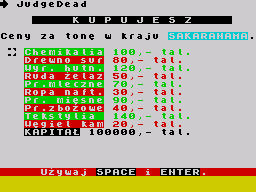
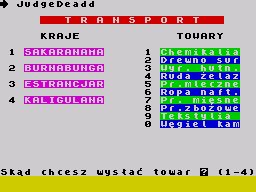
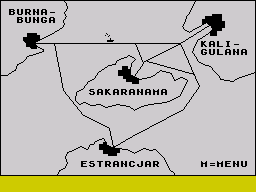
This is a text-based, spreadsheet-like strategy game built around menus and economic information rather than elaborate scenes. The important things to look at are the changing prices, your money, and the goods you hold, which suits a game asking you to make careful trading decisions turn by turn.
Story
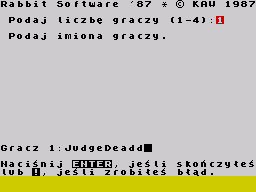
There is no authored campaign pulling you through a sequence of events. Instead, your story is the shape of your balance sheet: the bargain you spotted, the cargo you moved at the right moment, or the turn you skipped just before an unlucky financial setback.
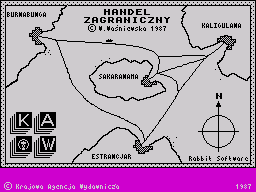
The merchant role is enough to give the numbers some context. You are not simply selecting abstract values; you are trying to build wealth through trade across four countries while other merchants chase the same broad goal.
That makes Handel Zagraniczny more of a self-made business tale than a narrative game. If you need characters or plot twists to stay invested, it will feel dry. If you enjoy recounting a close win in terms of one timely sale and one reckless gamble, it has a story every time you play.
Overall Experience
Handel Zagraniczny is a compact economic strategy game with a clean, unsentimental question at its center: do you move now, wait, or take a chance? Its small set of actions keeps the focus firmly on price movement, timing, and nerve, rather than burying you under rules.
The random event attached to skipping means you can never treat inaction as completely safe, and the ability for Player 1 to end the game gives the contest an unusually abrupt, tactical finish. Both ideas create moments where you have to commit rather than endlessly optimize.
Give it a chance if you like old-school trading games that make a few numbers carry the whole drama. It will not win over anyone looking for a rich world or a deep simulation of commerce, but as a brisk contest of buying, transporting, selling, and knowing when to quit, it has a sturdy competitive spark.


Reviews
There are no reviews yet.