 Retro Replay Retro Gaming History, Reviews & Emulation
Retro Replay Review
Gameplay
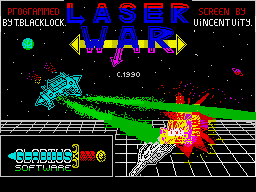
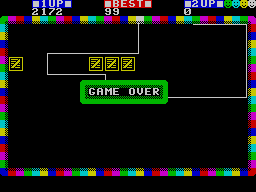
Laser War understands why the light-cycle idea has lasted: moving is easy, stopping is not an option, and every second makes the arena more dangerous. You and an opponent travel at the same time, each laying down a trail that becomes a wall. Hit your own trail, the other rider’s trail, or an obstacle, and your opponent takes the point. It is immediate, legible competition with no wasted setup.
The first few rounds are likely to be messy. You will box yourself in, misjudge the distance to a wall, and discover that a safe-looking route can vanish the moment the other rider cuts across the space you wanted. Then the rhythm starts to click. Rather than merely reacting, you begin saving room, threatening routes, and trying to make the opponent commit to a bad turn first.
Playing against another person is where the simple rules have the most bite. Every point feels like a tiny duel of confidence and panic, especially when both riders have painted much of the screen into a maze. The computer gives you a straightforward solo contest, but Laser War’s best moments come from sharing responsibility for the chaos with someone beside you.
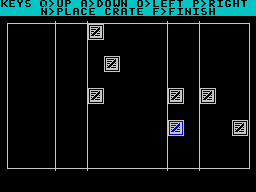
The obstacle-building option gives the game more staying power than a bare arena would have. Make a clean course when you want the contest to hinge on steering, or pack in barriers when you want quick traps and less room for recovery. Because collisions are so decisive, poorly placed obstacles can make a layout feel more like a coin toss than a contest; a little restraint produces the better tracks.
Graphics
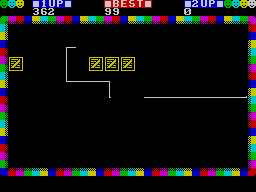
The top-down playfield keeps both riders, their growing trails, and the placed obstacles in one clear view. That simplicity matters: when the arena turns into a dense knot of deadly lines, you can still see exactly which turn ended the round.
Story
Laser War uses its futuristic light-cycle premise as a frame for competition rather than a narrative journey. You are here for another round, another point, and the chance to outlast the rider on the other side of the arena.
That stripped-down approach suits the game. A match creates its own miniature drama: an early mistake, a narrow escape, a deliberately cruel obstacle placement, or the moment somebody realizes there is nowhere left to turn. The score is the only story the game needs to tell.
If you want characters or a plot to pull you forward, this is not built for that kind of attachment. Its personality comes from the rivalry between two moving lines and the growing certainty that one of them is about to collide.
Overall Experience
Laser War is a lean arcade contest with a durable core. Its rules are simple enough that you can understand them in seconds, yet the shared-screen pressure creates the sort of rematches that happen naturally: one more round, then one more because that last crash was embarrassing.
The custom tracks are the feature that turns a neat Tron-inspired diversion into something you can shape around the people playing it. They let you tune the balance between open-space maneuvering and immediate, obstacle-heavy danger. That is especially valuable in a game whose basic ingredients are otherwise so spare.
Frustration is part of the package. A collision ends matters abruptly, and crowded courses can punish you before any clever plan has time to develop. Still, the restart is quick in spirit and the loss is usually understandable. When you lose, you tend to know the turn that doomed you.
Give Laser War a chance if you enjoy old-school head-to-head arcade games where a single screen and a few clean rules can produce real tension. It will not replace a deeper strategy game, but as a compact competitive reflex game—particularly with a human opponent—it earns its rounds.


Reviews
There are no reviews yet.