 Retro Replay Retro Gaming History, Reviews & Emulation
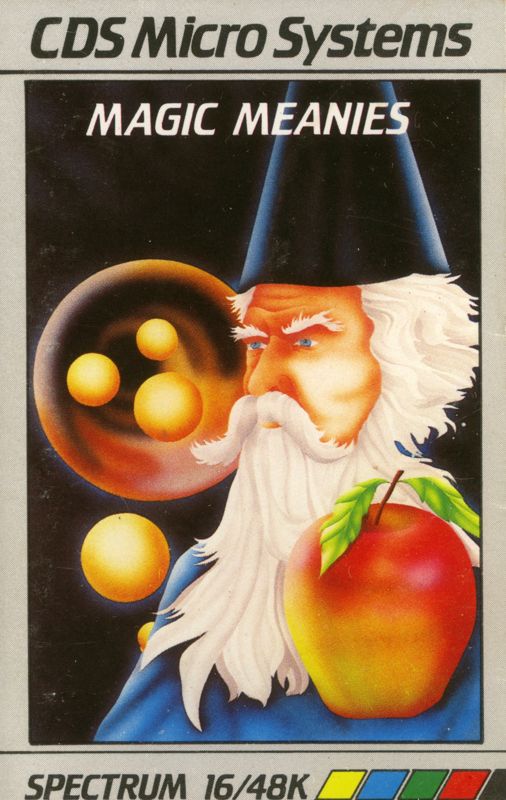

Retro Replay Review
Gameplay
The first minute of Magic Meanies is pleasantly unforgiving. You teleport into Zeldor’s field and immediately start threading Meltec through open green space, collecting blue lead crystals while Magic Meanies circle on black paths. The crucial twist is that movement does not stop on command: once you choose a direction, Meltec keeps marching until he reaches a screen edge or gets caught. That small rule turns the whole board into a series of commitments.
New paths appear behind you as you travel, and that is where the game starts to click. Making a shortcut toward a crystal may also hand the Meanies a fresh route to chase you down. Crossing one of their existing patrol paths makes that danger arrive sooner. You are not merely clearing pickups; you are constantly reshaping the maze and then dealing with the consequences. It has the clean, immediate logic of an early arcade game, but there is enough route planning to prevent it from feeling like pure reflex.
Your five crystal balls are a useful panic button, not a way to take control of the board. You can only fire in the direction Meltec is travelling, so an enemy at your back demands a fast turn at exactly the right moment. Killing a Meanie buys space, but every one is replaced, which means there is no safe phase where you can calmly sweep up the remaining crystals. Apples add the cleverest wrinkle: push one into a tunnel to obstruct a pursuer, or attempt the riskier play of undermining it so it drops onto a Meanie.
The magic cherry is the real target for advancing, while crystals and defeated Meanies feed the score. That makes each level a tense balance between grabbing points and taking the route that will actually let you reach the cherry alive. Skill settings from 1 to 9 give the game a direct way to raise the pressure. Frustration can set in when a committed move carries you into a chase you saw coming but can no longer avoid, yet that is also the point: Magic Meanies wants you to learn its routes through repeated, quick failures.

Graphics
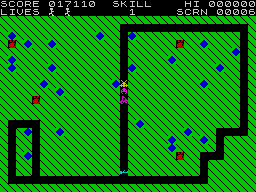
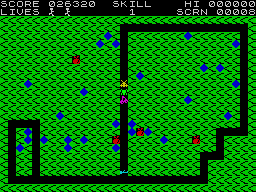
The screen is spare and functional: a green field, black paths, blue lead crystals, red apples, and the cherry stand out clearly enough to read while the Meanies close in. The fixed single-screen view suits the maze contest, since you can judge patrol routes and the paths you have created at a glance.

Story
There is just enough story to give the collecting a playful purpose. Meltec is a good wizard who can turn lead into gold, but the needed lead sits in neighboring Zeldor under the guard of the evil Magic Meanies. He teleports in to steal it, and the game sensibly gets on with the dangerous part.
That light setup fits the tone. You are not asked to linger over wizard lore or villainy; the plot exists to explain why a wizard is running for his life through a hostile field after glowing crystals. The names are broad and cartoonish, which works better here than a more serious fantasy frame would.
The cherry serves as the level-to-level objective, giving the action a clear finish line beyond score accumulation. Once three lives are gone, the game returns you to the familiar arcade ritual of entering a high-score name if your run earned it. For a game built around repeated attempts, that is all the narrative structure it needs.
Overall Experience
Magic Meanies is at its best when a plan collapses and you improvise: a Meanie finds your newest tunnel, you cannot stop moving, and you have to decide whether to shoot ahead, turn away, or shove an apple into the chase route. Those little emergencies give the game more character than its simple board initially suggests.
Its limitations are also inseparable from its charm. The board and goals are straightforward, enemies return after being killed, and a mistake can feel brutally final because momentum is mandatory. This is not a relaxed collecting game. It is a compact score attack built around learning how much danger each new path creates.
Give it a chance if you like old-school maze games that reward nimble hands and repeat play, especially if you enjoy turning an enemy’s route against it. The payoff is not variety so much as mastery: surviving longer, using apples more intelligently, and finding a cleaner line to the cherry than you managed last time.


Reviews
There are no reviews yet.