 Retro Replay Retro Replay gaming reviews, news, emulation, geek stuff and more!
Retro Replay Review
Gameplay
Makao gets moving immediately. You begin with five cards and the basic rule is wonderfully plain: lay down a card matching the suit or value already on the table, use a joker, or take a card when you cannot play. That simplicity is the hook. You can sit down without a long learning period, yet every turn asks whether a playable card should be spent now or saved for the trouble likely to arrive next.
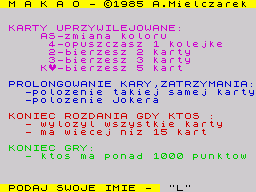
The mean streak comes from the special cards. A two, three, or king makes the next player draw cards; a four skips their turn; and an ace lets you change the active suit. The clever wrinkle is that matching the attacking card’s value, or using a joker, passes the penalty onward. That turns a simple draw punishment into a tense little chain reaction. A player who looks safely ahead can suddenly be buried under a growing penalty, while the person who timed a response card well escapes untouched.
There is real strategy in hand management, even within such a small ruleset. Hanging on to an ace gives you control over the suit, while holding an attack card can protect you from somebody else’s move or set up an attack of your own. Since a deal also ends when someone exceeds 15 cards, drawing is not merely an inconvenience; it can become a direct route to losing the deal. The computer handles the other three seats, so the game works as a solitary test of whether you can outplay a table that is constantly trying to disrupt your plan.
The downside is that chance remains a major force. You can make sensible decisions and still draw into a bad run, particularly when penalties begin to stack. That is part of the card game’s character rather than a flaw in translation, but it means Makao rewards patience with swings of fortune rather than deep long-term planning. Treat each deal as a brisk tactical scrap and its frustrations are easier to shrug off.
Graphics
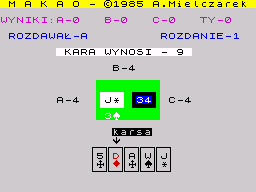
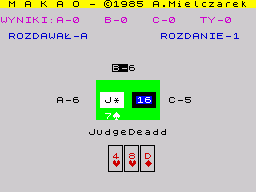
The view centers on the cards in your hand and the card on the table, fitting a game where suit and value are the information that matters from moment to moment.
Story
Makao has no narrative campaign to carry it. Its drama comes from the table: somebody changes the suit with an ace, another player answers a penalty card, and the apparent leader suddenly has to draw.
That stripped-down approach suits the material. A card game does not need a story when each deal can produce its own small reversal, especially once players are close to clearing their hands or risk passing the 15-card limit.
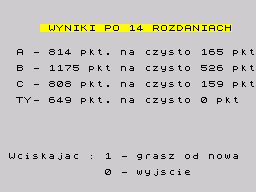
The larger arc is purely competitive. Deals award points based on cards left in hand, new deals begin, and the match ends once someone reaches at least 1000 points. If you want character-driven stakes, there is nothing here for you; if you enjoy score-chasing rivalries built one deal at a time, the structure is enough.
Overall Experience
Makao is a focused adaptation with a good instinct for what makes this style of card game bite: ordinary matching rules, then sudden punishment and opportunities to redirect it. The best moments come when you have just enough of a hand to steer the next few turns, only for another player to throw a king, a joker, or a matching counter into the sequence.
It will not convert anyone who dislikes luck-heavy card games. The computer opponents give you a full four-player table, but they do not replace the social spark of reading friends and enjoying their complaints when a draw penalty lands. Still, the underlying rules have enough interplay to make a computer match worthwhile when you want a quick tactical card session.
Give Makao a chance if Mau Mau variants appeal to you and you like card games that let a single saved card flip the pressure around the table. The path to 1000 points supplies a clear reason to keep starting new deals, while the compact rules make it easy to return after time away. It is modest, occasionally cruel, and more satisfying than it first appears once you learn when not to play the first legal card in your hand.



Reviews
There are no reviews yet.