 Retro Replay Retro Gaming History, Reviews & Emulation
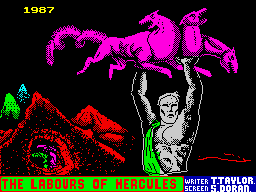
Retro Replay Review
Gameplay
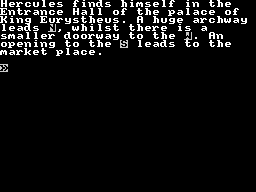
The first few minutes ask you to meet the game on its own terms. You read the description of where Hercules stands, form a plan from the details on screen, then type a command and see what happens. There is no action-game version of the twelve labours here; the satisfaction comes from turning a confusing situation into a workable sequence of ideas.
Greek mythology is a strong fit for this format because the objective already has weight. You are not merely roaming from room to room for a vague treasure hunt: you are working toward freedom through twelve near-impossible tasks. Knowing that formidable figures such as Cerberus and Hydra lie along the route gives each new land and obstacle a little extra pull.
The trade-off is familiar to anyone who has spent time with text adventures. Progress depends on close reading and on expressing your intentions through typed commands. When your train of thought matches the game’s demands, solving a problem can feel wonderfully personal. When it does not, the same setup can leave you staring at a description and trying to find the next useful idea. Bring patience, take notes if needed, and treat a stalled moment as part of the puzzle rather than a reason to rush.
Graphics
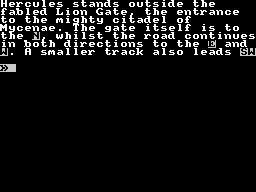
This is text only: you see descriptions of surroundings on screen and supply commands yourself. Hercules, the monsters, the lands, and the oceans are built in your head from the writing rather than shown as character art or animated encounters.
Story
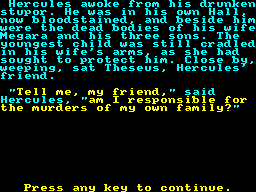
Its opening gives the adventure more gravity than a straightforward heroic quest. Hercules has murdered his own family in a moment of weakness, and the twelve labours are the price of being allowed to walk free again. That is a grim, effective starting point for a game about earning redemption through impossible work.
The story’s strength is its clean mythic shape. Each task carries Hercules farther across different lands and oceans while putting famous dangers in his path. You know the broad direction from the beginning, yet the individual challenges are where the journey earns its texture.
Do not come expecting a fast-moving, character-heavy drama. The narrative arrives through the places you examine and the situations you untangle. If you like myth as a framework for exploration and problem-solving, that restraint works; if you want the game to constantly narrate Hercules’s feelings or stage each confrontation, the text-adventure structure may feel remote.
Overall Experience
The Labours of Hercules is a compactly focused proposition: a classic Greek legend filtered through the deliberate rhythm of interactive fiction. Its best moments come when a description, a mythic objective, and your own deduction click into place. You are doing more than selecting the next chapter; you are helping Hercules think his way through the consequences of his sentence.
It is also unapologetically demanding. The entire experience rests on your willingness to read, experiment with commands, and tolerate uncertainty. That can make the game feel slow when you are stuck, but it also gives a successful solution more ownership than a guided adventure usually can.
Give it a chance if you enjoy old text adventures, puzzle-solving, and Greek myth with a darker edge. Skip it if you need visual action or rapid feedback. For the right mood, the twelve-labour structure supplies a satisfying reason to persist through the rougher stretches.



Reviews
There are no reviews yet.