 Retro Replay Retro Gaming History, Reviews & Emulation
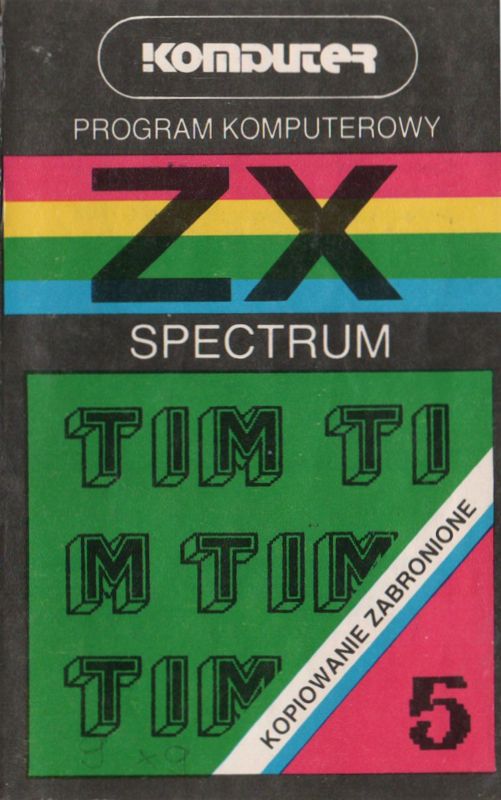

Retro Replay Review
Gameplay
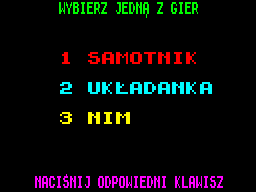
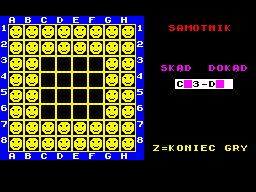
TIM begins with a refreshingly direct proposition: pick one of three classic puzzles and start thinking. Samotnik, its peg-solitaire game, has the most room to get its hooks into you. You jump one peg over a neighboring peg into an empty square, remove the jumped piece, and try to reduce the board to a single survivor. The 8-by-8 board starts with its central 16 squares empty, creating plenty of early options and, eventually, the familiar horrible realization that one careless jump has stranded the wrong pieces.
What gives Samotnik extra bite is that jumps can run horizontally, vertically, or diagonally. That makes it less predictable than a basic cross-shaped solitaire board. You can spot clever-looking chains, but you still need to think several moves ahead about which pegs will remain mobile. Entering coordinates to select a peg and its destination makes every move deliberate. If you enjoy working through a puzzle rather than casually shuffling pieces around, that severity is part of the draw; if you want quick, tactile play, it may feel laborious.
Układanka is a fifteen puzzle with letters instead of numbered tiles. Your task is to put the 15 letters into alphabetical order using the single empty space. It is the simplest game here to understand and the easiest to dip into, though the standard sliding-puzzle rhythm can become repetitive once you know what kind of spatial rearranging it asks of you. It works well as a change of pace after staring at Samotnik’s longer-term consequences.
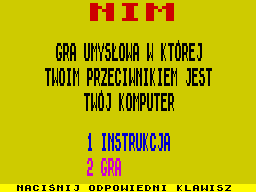
Nim is the quickest and cleanest contest in the collection. Two players remove any number of matches from one of three rows, and whoever takes the last match wins. Its rules take seconds to learn, but it punishes casual choices almost immediately. Against another person, it is the part of TIM most likely to prompt a rematch, because a loss often leaves you convinced you can see exactly where you went wrong.
Graphics
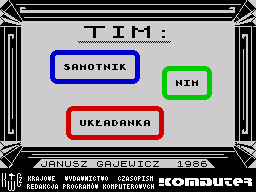
On ZX Spectrum, TIM keeps its focus on functional board views: pegs and empty squares for Samotnik, letter tiles for Układanka, and three match rows for Nim. The fixed, top-down layouts suit games built around planning positions, and the coordinate-driven solitaire play gives the board itself most of the visual importance.
Story
TIM has no narrative to carry you from one game to the next. It is a straightforward collection of abstract board and puzzle games, with each challenge standing on its own.
That absence fits the material. Samotnik creates its own tiny arc through the shrinking number of pegs: an open board full of promise turns into a tight endgame where every remaining piece matters. The tension comes from the state of the board, not from characters or plot.
Układanka and Nim are even more bare-knuckled. One is about restoring alphabetical order; the other is about leaving your opponent the wrong matches. If you need a theme or a story hook to stay engaged, TIM will not supply one, but the rules are clear enough to let the puzzles speak for themselves.
Overall Experience
TIM is small, stern, and more engaging than its plain setup first suggests. The collection earns its value through variety: solitaire offers solitary planning, the letter puzzle offers methodical tile work, and Nim brings competitive calculation. You can move among them without having to learn a complicated new language each time.
The biggest hurdle is the input style in Samotnik. Typing coordinates turns a simple-looking board game into a more formal exercise, and that can make mistakes or experimentation feel less breezy than they would with direct movement. Still, it also encourages the right mindset for the game: stop, inspect the board, then commit.
Give TIM a chance if you enjoy classic logic games in their most concentrated form and do not mind supplying your own patience. Samotnik is the reason to spend time here, Nim is the reason to bring a second person, and Układanka rounds out the package without overstaying its welcome. It is not a lavish collection, but its best puzzle has enough depth to reward repeated attempts.


Reviews
There are no reviews yet.