 Retro Replay Retro Replay gaming reviews, news, emulation, geek stuff and more!
Retro Replay Review
Gameplay
Charly earns its hook quickly. You know the basic job—get crates onto the specially marked squares—but the ability to pull a crate changes the rhythm of each top-down puzzle. Instead of only fearing the classic mistake of pushing a box into an unrecoverable corner, you are constantly looking for opportunities to back it out, reposition it, and make a route that a push-only game would deny you.
That kindness has a price: every single push or pull counts as a move, and moves are limited. The result is less about merely finding a solution and more about finding an efficient one. You can see a workable route and still lose because it takes too many crate moves to carry out. When Charly clicks, you stop treating pulling as an emergency escape hatch and start planning it into the whole route from the first crate.
Cracked tiles make the walking side of the puzzle matter too, since stepping onto one costs a life. Randomly appearing power-ups prevent the boards from becoming entirely dry exercises in calculation, though that randomness also makes the experience less cleanly controlled than a puzzle purist may prefer. Expect occasional irritation when a promising plan gets tangled in move economy, but that pressure is also what gives a solved board its payoff.
Graphics
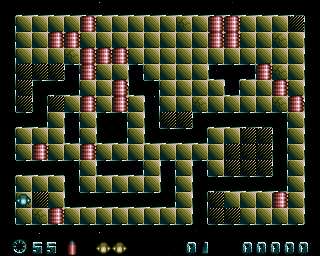
The top-down, fixed or flip-screen boards put the important pieces plainly in view: crates, marked goal fields, and dangerous cracked tiles. That direct layout suits a game where you need to trace positions and routes before committing to a move.
Story
Charly’s momentum comes from the state of the current board rather than from a tale carrying you between levels. A crate sitting one square from its target can feel like a triumph or a trap depending on the move budget, and that is where the game finds its drama.
Each puzzle creates its own tiny arc. You survey the layout, make a plan, discover that a pull has opened a new possibility, then realize that possibility may be too expensive. The strongest moments arrive when a route that looked impossible suddenly becomes clear.
If you need characters or plot beats to pull you through a game, this is unlikely to hold your attention for long. If you enjoy making your own stakes out of a tightly constrained puzzle, the board-by-board structure is enough reason to continue.
Overall Experience
Charly is a worthwhile variation on Soko-Ban because its central change is not cosmetic. Pulling crates broadens your options, while the move limit ensures that broader freedom never turns into careless experimentation. You are given a safety valve, then asked to use it with discipline.
Its friction is deliberate but not always gentle. Limited crate moves and life-losing cracked tiles mean small errors carry weight, and the random power-ups add a variable that may not suit anyone looking for perfectly authored, repeatable logic puzzles. Still, the game has a sturdy loop: study, commit, regret, revise, and finally execute a cleaner route.
Give Charly a chance if you already enjoy pushing-box puzzles but want one that lets you recover from more situations without making success easy. Its best levels should reward patient planning and economical movement; anyone who wants relaxed trial-and-error may find the move cap more punishing than inviting. For puzzle fans willing to meet it on its terms, the added pull mechanic makes this more than a routine clone.


Reviews
There are no reviews yet.