 Retro Replay Retro Gaming History, Reviews & Emulation

Retro Replay Review
Gameplay
Corx is built around one of arcade gaming’s cleanest ideas: drive, turn, leave a wall behind you, and do not touch any wall. The first few rounds are instantly understandable, but they are not necessarily easy. You can be cruising along confidently, trying to box in the other car, then realize a fraction too late that your own earlier trail has shut off the only escape route. That mix of clarity and sudden self-inflicted disaster is the game’s strongest hook.
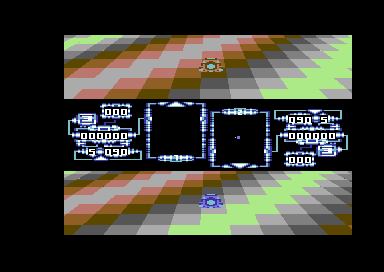
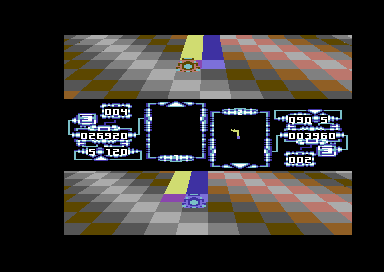
The split screen adds useful pressure rather than merely showing off. Your view is fixed on your own vehicle, while the opposing driver has a separate 3D view, and the central radar gives you a shared overhead read on the shrinking battlefield. You are not just reacting to the road immediately ahead; you are checking the radar, judging how much room remains, and deciding whether to slow down or make a risky move before the trap closes.
Limited jumps prevent the matches from becoming entirely predictable. Saving one for a moment when an opponent thinks they have sealed your fate can reverse a round, but wasting it leaves you exposed. Speed control matters for the same reason: going flat out is tempting, yet a slower pace can buy the turning room needed to make a cleaner enclosure. Two AI difficulty levels give solo matches some range, though Corx is plainly at its most alive when another person is steering the second car.
Its limitation is also its point. Only two vehicles share the field, so this is not a sprawling multiplayer arena where chaos creates the fun. Every match is a concentrated duel, and if you do not enjoy repeated rounds of reading an opponent’s habits, baiting turns, and dying to your own greedy line, the concept may wear thin. The knockout tournament option helps when more people are around, turning a sequence of head-to-head bouts into something worth passing the controller for.
Graphics
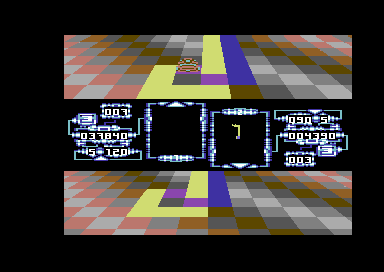
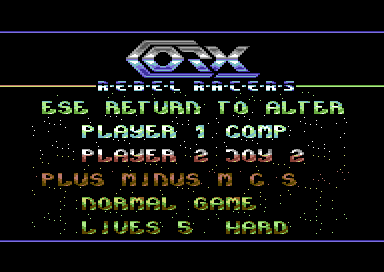
Corx divides the screen into three clear slices: a 3D view from each driver’s perspective at the top and bottom, with the radar placed between them. The plain playing field and the cars’ growing trails keep the important information in focus, while the radar is where you can quickly see the larger shape of the duel.
Story
There is no story campaign pulling you through Corx. Its sci-fi framing is carried by the futuristic car-and-trail contest itself: two rivals enter the same plain, make the available space deadlier with every turn, and only one survives the battle.
That lack of narrative is not a problem for a game this direct. Each round makes its own tiny drama out of an overconfident charge, a narrow escape, or a trap that looked perfect until the other driver jumped it. The best moments are easy to recount afterward because the entire contest hinges on one decision.
Do not come in expecting characters or plot to deepen the premise. Corx treats the duel as the whole story, which suits its arcade focus but leaves little to hold onto once the competitive tension fades.
Overall Experience
Corx is a compact competitive arcade game with enough tactical variation to make its straightforward rules bite. The radar, speed adjustment, and limited jumps turn a basic trail-dodging contest into a game of spacing and nerve, especially once both drivers understand that reckless speed is often a gift to the other side.
It is worth a chance if you want a quick two-player rivalry rather than a long-form racing game. The rounds are easy to start, the losses are usually understandable, and a small tournament gives friends a reason to stay involved even though only two cars race at once.
The payoff depends on who is sitting beside you. Against a human opponent, Corx can produce sharp, tense little duels where every turn matters. Alone, its two AI settings provide a serviceable challenge, but the game’s real personality comes from trying to outthink someone who is watching the same shrinking field and hoping you blink first.


Reviews
There are no reviews yet.