 Retro Replay Retro Gaming History, Reviews & Emulation
Retro Replay Review
Gameplay
First Contact puts you in the uncomfortable position of being the station’s planner rather than its hands. Aliens overrun a communication station and smash its vital components, while your maintenance droid is left to keep things working for as long as possible. You do not directly drive that droid around. You program a sequence of actions, then watch it carry out your instructions on its own. That small change turns a familiar save-the-base setup into something much tenser.
The first hour is about accepting that you cannot simply react at the instant something goes wrong. A repair route has to make sense before the droid starts it. You must account for collecting repair equipment from lockers, refuelling, reaching the right location, and dealing with damage across four decks linked by teleports. When the plan works, it feels earned: you anticipated a problem and sent your machine on a useful chain of jobs instead of frantically chasing one emergency.
Frustration arrives when aliens interrupt a droid. It stops its program, does not fight back, and must be manually restarted. That can feel harsh, particularly because every interruption exposes how much you were relying on a carefully arranged routine. But it also gives the game its bite. You are not just optimizing travel; you are building plans that can survive disruption, then deciding which stalled job is worth rescuing first.
Splitting the original unit into three droids with different abilities is where the strategy gains real momentum. Each one needs its own program, so success becomes a matter of coordination rather than merely writing a longer script. One or two disabled droids can be repaired, but losing all of them ends the game. The result is a smart, demanding survival exercise that rewards patience and a willingness to learn from a broken plan.

Graphics
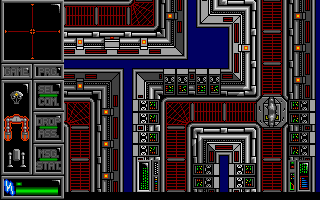
First Contact uses a top-down view suited to its four-deck station layout. Teleports, lockers, droids, and damaged areas are part of a functional sci-fi workspace rather than a decorative backdrop, and the overhead perspective fits the game’s emphasis on routing machines through a station under pressure.
Story
The story is deliberately lean: a communication space station has been overrun by aliens, and its maintenance machines are the last line between ongoing operation and total failure. That is enough because the drama comes from the work itself. Every broken vital part turns the broad invasion premise into an immediate practical problem.
You are not asked to be a gun-toting hero. You are the person trying to keep infrastructure alive while hostile forces steadily make that task harder. The droids cannot fight back when interrupted, which gives the conflict a vulnerable, almost desperate angle. Your response is preparation, repair, and persistence.
Because the goal is simply to keep the station running as long as possible, First Contact creates its own stories through failure and recovery. A droid stranded mid-program, a repair task abandoned, or a damaged unit brought back online can matter more than a scripted plot twist would. It is spare science fiction, but the premise and systems pull in the same direction.
Overall Experience
First Contact is a good fit if you enjoy strategy games that make you think ahead and then live with your decisions. Its scripting focus asks for more patience than direct-control tactics, and the game can be unforgiving when an alien interruption wrecks a useful routine. Still, that friction is purposeful rather than arbitrary: the station is in crisis, and your automation is never completely safe.
The strongest moments come after the rules start to click. You stop seeing the droid as a remote-controlled worker and start treating it as a limited resource whose time, route, fuel, and program all matter. Adding more droids broadens your options while increasing the mental load, a trade-off that keeps the station from ever feeling comfortably under control.
It earns its 7/10 through a focused concept and the satisfying pressure of managing multiple maintenance emergencies with imperfect automation. Give it a chance if the thought of writing and revising droid routines sounds more exciting than shooting aliens yourself. If you need immediate control and constant action, its stop-start programming loop may test your patience; for the right kind of strategist, though, that loop is the point.



Reviews
There are no reviews yet.