Retro Replay Retro Gaming History, Reviews & Emulation
Some games are great. Some games are terrible. And then there are games like Stubbs the Zombie, which are just… interesting.
The premise is interesting. Both good and bad. The gameplay is interesting. Also good and bad. But just because a game is interesting doesn’t necessarily mean it’s a good game, right?
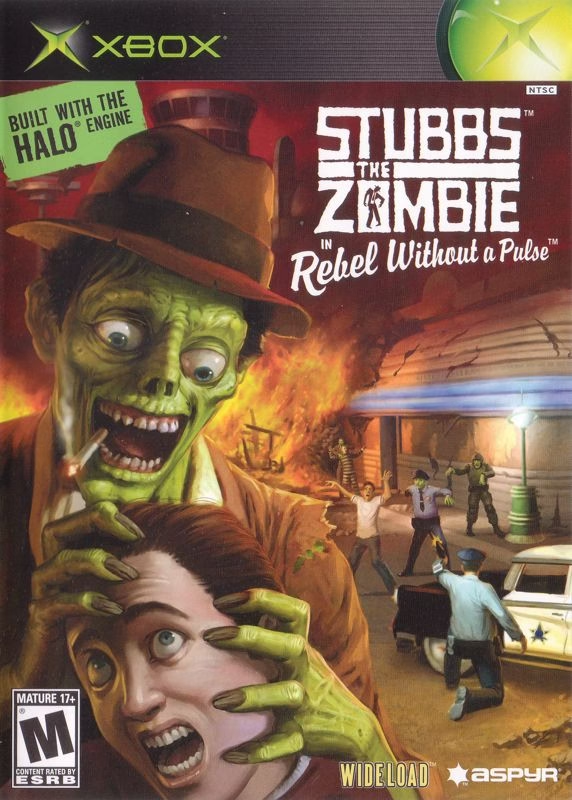
On 18 October 2005, Stubbs the Zombie in Rebel Without a Pulse arrived on the original Xbox, offering players a rather unusual opportunity: instead of trying to survive the zombie apocalypse, you got to START one.
I remember when I first played this one. I wasn’t entirely sure what I was expecting, but it definitely wasn’t what I got!
Just looking at the cover art, with its fedora-wearing undead protagonist and pulpy presentation, I was almost expecting some kind of detective noir adventure. Maybe a supernatural mystery involving a wisecracking zombie private investigator.
Nope.
What I got was a game about shambling around, killing humans, and eating their brains.
You know, zombie stuff.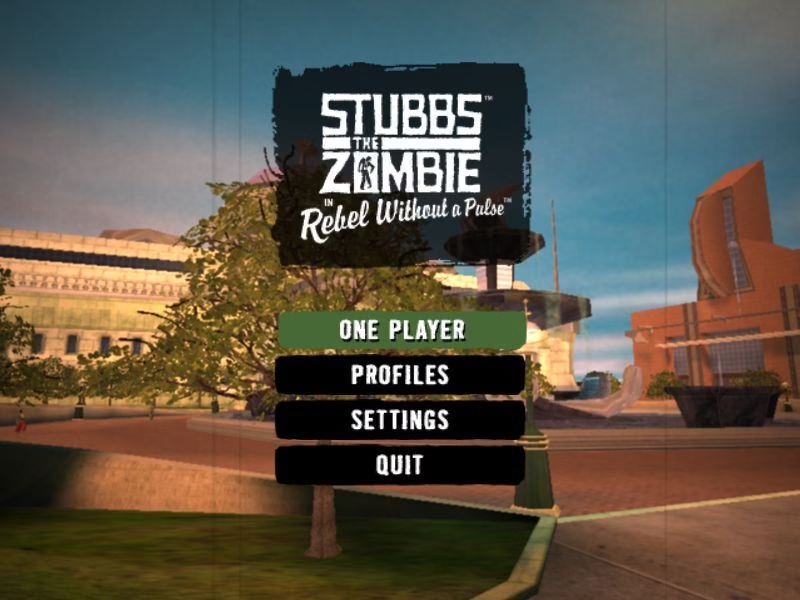
A Zombie with a Past
Developed by Wideload Games and published by Aspyr Media, Stubbs the Zombie takes place in the fictional city of Punchbowl, Pennsylvania, during the 1950s.
But this isn’t quite the 1950s we remember.
Punchbowl is a retro-futuristic wonderland filled with flying cars, robots, advanced technology, and all the optimistic nonsense people once imagined the future would look like. It’s a shiny, supposedly perfect American city where science has seemingly solved every problem.
Except for the dead guy climbing out of the ground.
Edward “Stubbs” Stubblefield was a traveling salesman who met an unfortunate end decades earlier. Now he’s back from the grave, and his arrival threatens to turn Punchbowl’s technological utopia into an all-you-can-eat buffet.
Naturally, there’s more to his story than an inexplicable craving for human brains, and the game gradually reveals why Stubbs has returned and what connects him to the city.
The whole thing is presented as a grotesque parody of 1950s American culture, blending science-fiction camp, zombie movies, social satire, and a healthy disregard for good taste.
And I absolutely loved the aesthetic.
The retro-futuristic buildings, vehicles, advertisements, and colorful characters were easily among my favorite parts of the experience. There’s something wonderfully absurd about unleashing a zombie apocalypse in a world that looks like it was designed by the people who brought us The Jetsons.
 From the People Behind Halo… Sort Of
 From the People Behind Halo… Sort Of
For the record: Stubbs the Zombie was the first game from Wideload Games, a studio founded by Alex Seropian, one of the original founders of Bungie.
Yes, THAT Bungie.
In fact, the game was built using a modified version of the engine that powered the original Halo: Combat Evolved.
That’s a pretty impressive pedigree for a game about eating brains and weaponized flatulence.
Wideload itself was something of an experiment. Rather than employ a massive permanent development team, Seropian assembled a small core group and relied heavily on outside contractors to help build the game.
The goal was to create a more flexible independent studio that could take creative risks without the overhead of traditional big-budget development.
And whatever you think of the finished product, it’s difficult to argue that Stubbs the Zombie wasn’t a creative risk.
Brains, Bad Jokes, and Questionable Bodily Functions
At its core, the gameplay is relatively simple.
You’re a zombie. Humans are walking around with perfectly edible brains. Your job is to correct that situation.
But there’s a twist.
When Stubbs kills humans, they can rise again as zombies themselves, joining his growing undead mob. Before long, you’re leading an army of shambling corpses through the city, turning Punchbowl’s residents against one another.
It’s a clever mechanic, and watching your little zombie outbreak spread is probably the game’s most satisfying feature.
Stubbs also has a collection of wonderfully disgusting special abilities.
He can unleash noxious gas to stun enemies, throw explosive organs, detach his own head and roll it like a bowling ball, or send his severed hand crawling around to possess unsuspecting humans.
Possession is especially entertaining because it lets you turn your enemies’ own weapons against them.
There are also vehicles, occasional puzzles, boss encounters, and some truly bizarre sequences that feel like the developers were simply throwing ideas at the wall to see what would stick.
And the humor?
Well, let’s just say the writers weren’t particularly concerned with sophistication.
 The game is packed with sight gags, double entendres, crude jokes, sexual innuendo, and the kind of sophomoric humor that makes you wonder whether the developers were having more fun creating the game than anyone would have playing it.
Some of it works. Some of it gets old.
But it certainly gives the game personality.
Great Ideas Don’t Always Make Great Gameplay
Here’s where my feelings about Stubbs the Zombie get a little complicated.
I had fun playing it. There’s no question about that.
The concept was fresh, the setting was fantastic, and the ability to create your own growing zombie army was genuinely entertaining.
There were also plenty of technical oddities.
I remember NPCs getting stuck against what appeared to be invisible walls, enemies behaving strangely, and the occasional character seemingly floating several feet off the ground.
Nothing I encountered was particularly game-breaking, but it was noticeable. These little bugs and glitches kept reminding me that, for all its imagination, this wasn’t the most polished experience.
The game’s pacing was good, but the playloop got a bit stale at times. It’s almost as though the developers had a notebook filled with wonderfully ridiculous ideas but weren’t entirely sure how to make them work together.
The Music Deserves Some Credit
One of the more unusual elements of Stubbs the Zombie was its soundtrack.
Rather than simply rely on traditional 1950s recordings, the developers assembled an assortment of contemporary artists to perform covers of songs from the era.
Bands and musicians including Death Cab for Cutie, Cake, and The Flaming Lips contributed to the soundtrack, giving classic tunes an unusual modern twist while still complementing the game’s retro setting.
It’s a clever touch that fits the game’s overall personality: familiar on the surface, but just a little bit twisted underneath.
A Cult Classic Worth Remembering
 A Cult Classic Worth Remembering
Despite its imperfections, Stubbs the Zombie earned enough of a following to survive well beyond its original Xbox release.
The game also appeared on PC and Mac in 2005 and eventually returned to modern platforms in 2021, introducing a new generation of players to Punchbowl and its most unwelcome visitor.
That doesn’t surprise me.
There’s something to be said for a game that tries something different, even when the execution doesn’t quite live up to the idea.
And Stubbs the Zombie was definitely different.
Looking back, I don’t regret playing it. I enjoyed the quirky setting, the ridiculous humor, and the novelty of being the monster for a change.
It was a fun experience, and I’m glad I played it. But I just don’t think being memorable and being genuinely great are necessarily the same thing.
Maybe that’s the best way to remember Stubbs the Zombie. It wasn’t a masterpiece, and it wasn’t a disaster. It was an interesting experiment with some genuinely fun ideas, a terrific aesthetic, and enough humor to keep it from getting dark.
Sometimes that’s enough to make a game worth playing.
Did you play Stubbs the Zombie on the original Xbox? Was it an underrated cult classic, or another great idea that never quite lived up to its potential?