 Retro Replay Retro Replay gaming reviews, news, emulation, geek stuff and more!
Retro Replay Review
Gameplay
Frontline gets to the point quickly: you command small infantry squads in World War II scenarios, and every assignment carries a cost. Give a squad a capable leader and its morale improves; attach a heavy machine gun and it gains firepower but loses speed. That trade-off is the heart of the game. You are not merely pushing counters toward an objective—you are deciding which squad can move, which one needs to hold ground, and which one cannot afford to lose its nerve.
Cover makes those choices matter. Walls and shell holes can protect troops on the varied maps, so the best move is often the least dramatic one: get into cover, preserve the squad, and avoid turning an advance into a rout. Artillery pieces with crews broaden the available tools, but Frontline remains focused on the immediate problems of infantry command rather than swelling into a huge operational simulation.
The first hour is likely to be spent learning how much weight the game gives to leadership, morale, movement, and support weapons. Its two tutorial missions are useful because the interface is icon-driven and menu-based, with the kind of deliberate handling that asks for patience. Once the relationship between equipment and mobility clicks, the game’s restraint becomes a virtue. Frustration will set in if you want rapid-fire action; Frontline wants you to pause, assess terrain, and accept that a better-equipped squad is not always the better squad for the job.
Graphics
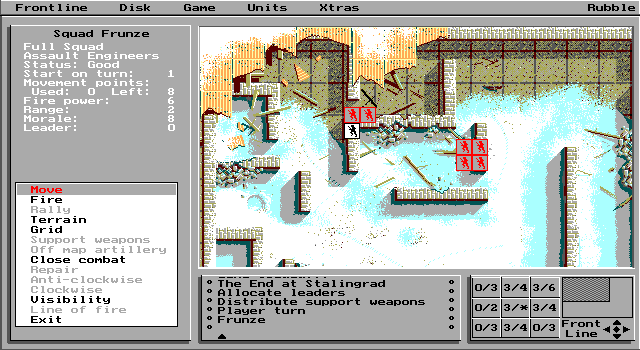
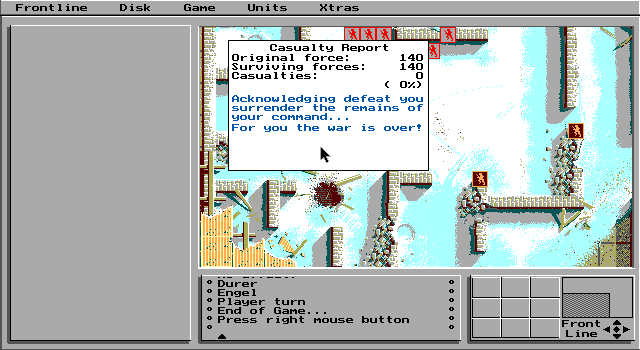
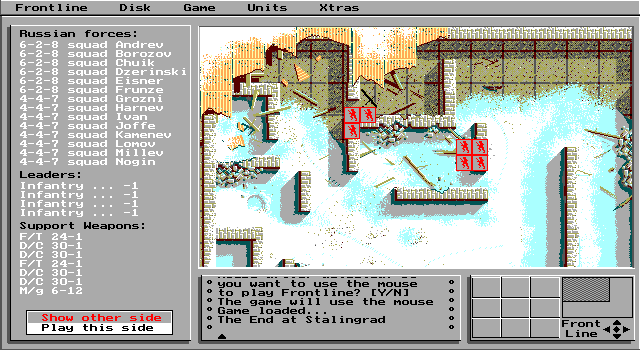
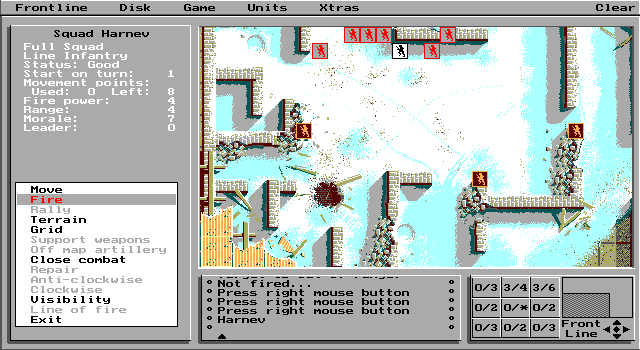
The top-down battlefield view is built for following small-unit positioning across walls, shell holes, artillery, and infantry squads. It is a functional military board-game look: the important visual question is where your men can move and where they can take cover.
The icon-driven menus are part of that same direct, utilitarian style. They suit the game’s command-heavy pace, though they can feel less inviting than more immediate tactical interfaces.
Story
Frontline tells its war through scenarios rather than through a character-led narrative. Monte Cassino in 1944, Guadalcanal in 1942, Stalingrad in 1943, and Pegasus Bridge in 1944 give each battle a recognizable historical frame, and that is enough to lend your orders some weight.
Do not expect a campaign of personalities or dramatic plot turns. The story is in the situation: a squad leader keeping morale intact, a weapon team limiting movement, and a unit trying to make productive use of the cover in front of it.
That stripped-back approach fits the game. By concentrating on named fronts and discrete engagements, Frontline makes the historical setting feel like a sequence of tactical problems rather than an excuse for a long cinematic war story. You will get more from it if the locations themselves already spark your interest.
Overall Experience
Frontline is a focused squad tactics game with better ideas than flash. Leadership affecting morale and support weapons affecting movement are not decorative details; they force you to think about composition and positioning before committing troops. The result can be satisfyingly tense when a cautious plan holds together.
Its age shows in the menu-led interface and compact scope, and the pace will test anyone who wants instant feedback from every order. But it also avoids clutter. Each scenario asks you to manage a small set of meaningful variables instead of drowning you in a vast command structure.
Give it a chance if you enjoy deliberate World War II tactics and like games where terrain, morale, and squad equipment pull against one another. Skip it if you need a story-driven campaign or a brisk, action-first battlefield game. For patient armchair commanders, the payoff is a concentrated tactical challenge that still understands why small decisions matter.

Reviews
There are no reviews yet.