 Retro Replay Retro Gaming History, Reviews & Emulation
Retro Replay Review
Gameplay
Overrun! grabs you by making command feel precarious rather than all-powerful. Units do not politely wait for a conventional turn to end; actions unfold in continuous twenty-second chunks, and you stop the flow when you need to redirect the battle. At first, that can feel like the game is rushing you toward a mistake. Once it clicks, though, the pressure becomes the point. You are watching a plan survive—or unravel—in motion.
Orders are the crucial constraint. Command units gain and spend them, so you cannot endlessly micromanage every squad, tank, gun, and helicopter. A unit with no orders keeps doing what it was doing or reacts to trouble, while the loss of its superior hands control to the computer. That is a harsh rule, but it gives every command decision weight. Protecting the chain of command is not background administration; it is the difference between a controlled attack and a battlefield you can no longer steer.
The underlying simulation is impressively exacting. Unit size, morale, current circumstances, weapon statistics, and armor location all feed into combat effectiveness. Facing matters, which makes careless vehicle movement dangerous, and smoke from fired rounds, burning vehicles, or vegetation can alter the terrain picture as a fight develops. The line-of-sight tool is a welcome practical aid, because this is a game where firing blindly or advancing without checking the ground can ruin a good force quickly.
There is friction here, and not all of it is thrilling. The map covers only fifty yards per square and has just one outward zoom level, so you will scroll frequently to understand a wider engagement. The command menus are abbreviated and nested, while the manual goes deep enough to include formulas and a long table supplement. If you want a breezy tactical game, this workload will feel punishing. If you enjoy learning a system until its numbers become battlefield instincts, the detail pays off.
Graphics
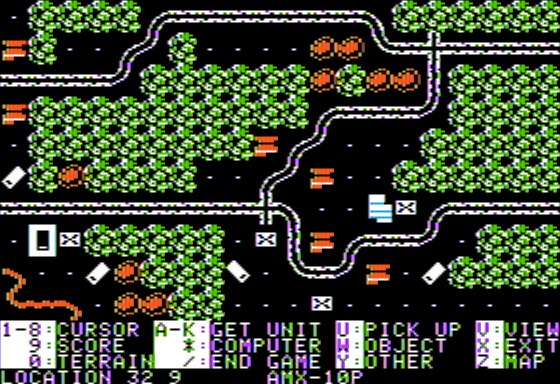
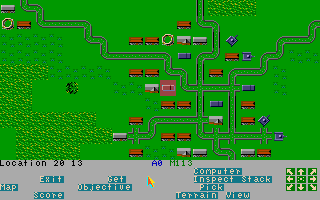
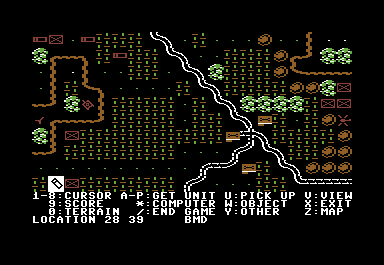
The view centers on a small-scale top-down map, with a status line for the chosen unit or terrain and command menus beneath it. It is a utilitarian battlefield view built around tracking positions, terrain, and lines of sight rather than admiring individual troops or vehicles. Smoke and burning terrain matter because they change conditions on that map, giving a fight visible consequences as it develops.
Story
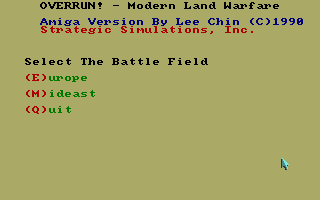
This is a military-scenario game, so its stories come from the situation you are handed and the mistakes you make under pressure. Most battles are speculative near-future clashes across European and Middle Eastern terrain, putting Arab states, Iran, Israel, NATO, and Warsaw Pact forces into conflicts that invite plenty of alternate-history what-ifs.
The standout historical anchor is the 1973 Arab-Israeli October War. That gives the scenario list one concrete real-world conflict among the hypothetical engagements, while an Iranian invasion of Kuwait shows the sort of near-future premise the game also explores. The framing is broad, but it is enough to make the opposing forces and battlefield choices feel less abstract than a generic red-versus-blue exercise.
The single-player campaign adds its own ongoing narrative. You begin with a core force on randomly generated maps and try to retain and expand it through victories. There are no authored character beats to lean on; the attachment comes from getting your own surviving force through another difficult operation and seeing whether your hard-won experience carries forward.
Overall Experience
Overrun! is rewarding because it refuses to make command clean or comfortable. Its best moments arrive when you pause the ongoing action, recognize that smoke, terrain, armor facing, and a stretched command structure have changed the odds, then issue the few orders that might still save the situation. It asks for attention, but it gives your decisions consequences in return.
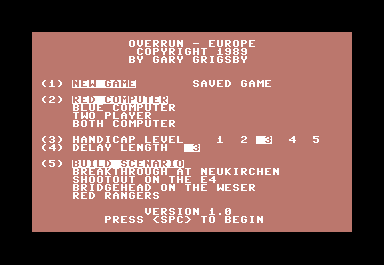
The scenario options add useful longevity: you can play alone, face another person hot-seat, or let the computer run both sides. More importantly, the editor allows custom maps, starting forces, engagement types, objectives, and five difficulty levels. For a rules-heavy tactical game, that flexibility matters; it lets you shape the sort of battlefield problem you actually want to solve.
Give it a chance if you enjoy old-school wargames that expect you to read, test, lose, and gradually become competent. The campaign’s persistence and the editor make the effort easier to justify, while the continuous action keeps the intricate rules from becoming purely academic. You will spend time scrolling, consulting the manual, and recovering from nasty surprises. But for the right kind of strategist, that tension is not a flaw—it is exactly why Overrun! remains compelling.


Reviews
There are no reviews yet.