 Retro Replay Retro Gaming History, Reviews & Emulation
Retro Replay Review
Gameplay
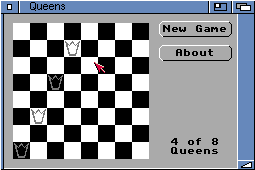
Queens wastes no time dressing up its challenge. You place eight chess queens on a board, with the familiar restriction that no queen may share a row, column, or diagonal with another. If you know chess movement, you know the rulebook; the puzzle is in turning that knowledge into a full-board solution.
The first placements feel deceptively easy. Put down a queen and you have claimed a row, a column, and two diagonals, but it is only after several choices that the board begins to tighten around you. That delayed pressure is where Queens earns its name. A position that looked harmless early on can leave no viable room for the final queen, so you are pushed to think beyond the next move.
Its point-and-select approach suits the task well because this is a puzzle about observing the board, reconsidering a layout, and trying again. There is no tactical chess match to manage and no opponent to outplay. You are facing a single, exacting spatial problem, which makes it a good fit for a short session when you want your brain engaged without committing to something bigger.
The downside is equally clear: there is only one core idea here. If the eight-queens problem does not grab you, Queens will feel more like a classroom exercise than a game. But if you enjoy puzzles where a small rule set produces surprisingly stubborn decisions, the clean focus is a strength rather than a limitation.
Graphics
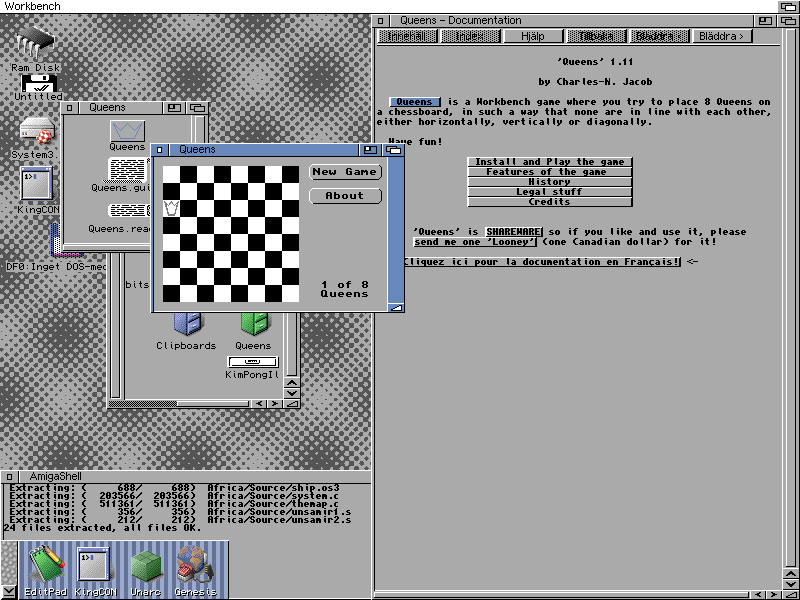
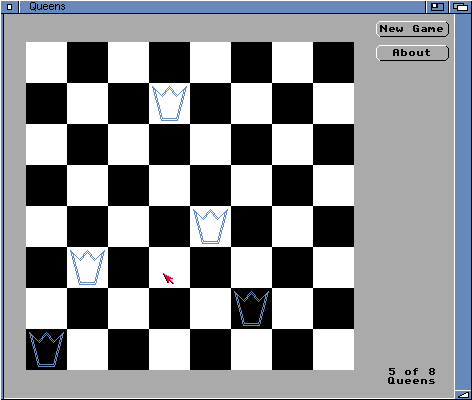
Queens uses a top-down chessboard view centered on the pieces and the spaces between them. That direct layout makes the important information easy to inspect: you can see the rows, columns, and diagonals that each queen threatens without visual clutter getting in the way.
Story
There is no narrative detour between you and the puzzle. Queens is built around an abstract chess problem, and it stays there.
That suits the game’s compact scope. Instead of asking you to follow characters or chase a larger goal, it lets the changing state of the board create the tension: every queen placed narrows the answer.
The result is a game with no story to carry the weaker moments, but it does not need one if the central challenge clicks for you. Your progress is the story here, from an open board to a solved arrangement that finally obeys every constraint.
Overall Experience
Queens is a modest but honest puzzle game. It takes a famous chess challenge and gives it a straightforward home on the Amiga, with enough friction in the logic to make a correct solution feel earned.
Give it a chance if you like Sudoku-style elimination, chessboard puzzles, or compact games that reward patient visual reasoning. You will get the most out of it by resisting the urge to place queens greedily; pause after each move and consider what the diagonals will do to the rest of the board.
It is not a broad, varied puzzle package, and it does not pretend to be. Queens succeeds by keeping one well-known problem clear and accessible. For the right mood, that is enough: a quiet, concentrated challenge with a satisfying finish once all eight pieces coexist.



Reviews
There are no reviews yet.