 Retro Replay Retro Replay gaming reviews, news, emulation, geek stuff and more!
Retro Replay Review
Gameplay
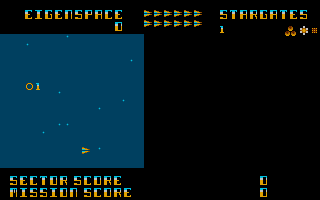
The first hour of SpaceCutter is spent learning that escape is less about reflexively blasting aliens and more about treating the universe like a route-planning problem. You are stuck in the Whirligig and need five solids to open a portal back to Earth, but the destinations are not a total mystery: their locations are disclosed in the manual. With billions of mathematically linked eigenspaces and a limited number of star gates in each, you can actually sit down and plan where to go. For the right kind of player, that is the game’s strongest and most distinctive idea.
Once that clicks, the resource model gives your plan teeth. Fuel drains while you steer, accelerate, or brake, while coasting straight costs nothing. Missiles and chaff are finite too, so it is possible to turn a route that looked efficient on paper into a dangerous mess through a few bad corrections or panicked fights. Space stations offer replenishment, but their placement also follows a mathematical logic, meaning they belong in your calculations rather than serving as a simple safety net.
There is real tension in that setup, but the controls are likely to be the dividing line. The Meson-class fighter is flown with mouse movement: push forward to accelerate, then manage direction and speed with the same device. That is an ambitious control scheme, yet it asks a lot when fuel is spent on basic handling. Combat can be particularly harsh because a heat-seeking missile fired without an enemy targeted hits your own ship. Chaff handles nearby threats, but limited supplies ensure that neither weapon becomes a carefree answer.
SpaceCutter rewards deliberate play more than improvisation. If you enjoy drawing routes, accounting for supplies, and accepting that navigation itself is the challenge, its connected-space puzzle can become absorbing. If you mainly want crisp spaceship dogfights, the mouse steering, fuel economy, and self-destructive missile mistake may wear down your patience long before the portal is in reach.

Graphics
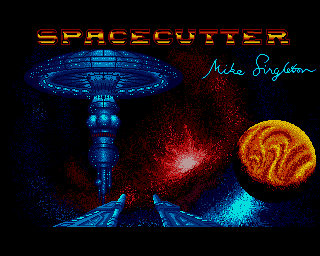
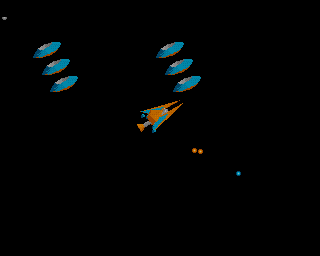
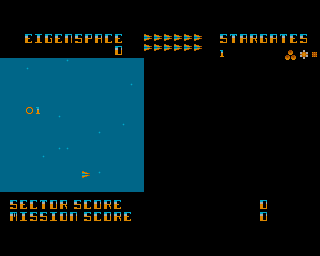
The action takes place on flat, multi-directionally scrolling space fields, viewed around the player’s ship rather than through a cockpit. Ships, stations, gates, and other objects use a three-dimensional look against those flatter fields, giving the screen a slightly unusual mix of 2D navigation and dimensional-looking space hardware.
Story
SpaceCutter keeps its story lean: you are trapped inside the Whirligig, and the five solids are your way to make a portal back to Earth. It is a functional objective, but a good fit for a game built around plotting an escape route through an enormous network.
The setting’s most useful narrative contribution is the sense of being lost in a place that follows rules you must learn. The eigenspaces are vast in number, yet their connections are mathematically defined, turning an intimidating premise into something you can gradually reason through. That makes progress feel earned through understanding rather than luck.
Do not expect the narrative to carry you through difficult stretches. The motivation stays focused on escape, while alien ships and space stations exist chiefly as pressures and aids along the journey. The payoff is therefore practical: assembling the means to get home after successfully navigating the Whirligig’s logic.
Overall Experience
SpaceCutter is a fascinatingly severe piece of space action. It asks you to prepare outside the immediate moment, travel with purpose, and preserve resources in a way many arcade-flavored sci-fi games do not. The manual’s route information is especially important: instead of spoiling the game, it turns the larger task into a solvable expedition.
That intelligence comes packaged with friction. Flying costs fuel whenever you make corrections, weapons are scarce, and firing a missile carelessly can punish you with a hit on your own ship. These rules create stakes, but they also make every clumsy moment feel expensive. You need to be willing to learn its particular rhythm rather than expect it to meet you halfway.
At its best, SpaceCutter makes a successful leg of a planned journey feel like a small triumph of navigation and survival. At its worst, you are wrestling its control demands while watching valuable resources disappear. Give it a chance if the thought of mapping a mathematically connected space maze sounds more exciting than exhausting; otherwise, its clever central design may not be enough to overcome the strain.


Reviews
There are no reviews yet.