 Retro Replay Retro Replay gaming reviews, news, emulation, geek stuff and more!

Retro Replay Review
Gameplay
Ball Breaker starts with a rule you know by heart: keep the ball alive and erase every block. Then it makes your hands hesitate. The paddle sits fixed along the right side of the screen, so your movement is strictly vertical rather than the usual left-to-right sweep. Early on, that feels like Breakout played at a slightly wrong angle. You have to recalibrate your instincts, judge returns from the side, and accept that a missed line is often your own bad read rather than bad luck.
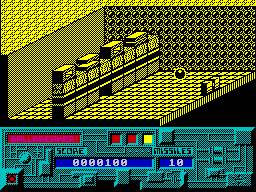
Its isometric board is more than decoration because blocks are stacked. Knock away the lower pieces and the blocks above drop down, changing the routes available to the ball. That gives each cleared section a modest puzzle-game kick. You are not merely thinning a flat wall; you are trying to open up useful collapses and avoid leaving irritating high blocks in hard-to-reach positions. Once this starts to click, Ball Breaker has a satisfying rhythm of careful placement followed by chaotic rebounds.
Missiles are a smart pressure valve. Their limited supply lets you remove a troublesome block directly, or deal with aliens that arrive in higher levels and cannot be touched by the paddle. Use them too freely and you may regret it; save them too long and a nasty obstruction can turn a manageable board into a scramble. The action remains simple, but that small resource decision gives the game more bite than a standard paddle-and-ball routine.
Frustration comes from the same thing that makes the game distinctive. Side-mounted paddle control demands precision, and the stacked layout can leave you chasing one stubborn block after the board has otherwise been cleaned out. If you want a relaxed, effortless brick breaker, this can feel fussy. If you enjoy learning the geometry of an arcade game through repeated attempts, the unusual orientation gives it a reason to exist.
Graphics
The isometric playfield is the key visual hook. Blocks rise in stacks rather than forming a flat ceiling, and watching higher blocks drop into the space left by destroyed lower ones makes the board state easy to understand. The ball and vertically moving paddle remain on the lower plane, so the game’s unusual perspective stays legible even while rebounds get busy.
Story
There is no narrative journey to carry Ball Breaker. Its context is entirely in the immediate arcade situation: clear the blocks, survive the rebounds, and handle the aliens that start appearing as the levels climb.
That is appropriate for a 1987 paddle game, and the lack of story is not a distraction. The changing board shapes do the work that a more elaborate game might ask from stages or plot: each new arrangement asks you to reassess your angles and your missile supply.
You should come to it for a clean mechanical challenge, not characters or a destination beyond the next cleared board. The reward is the moment a stack collapses into a more favorable shape and a difficult screen suddenly looks solvable again.
Overall Experience
Ball Breaker is a worthwhile oddity for anyone who likes Breakout but wants the formula to fight back a little. The sideways paddle and stacked isometric blocks force you to learn a different set of angles, while falling blocks add just enough tactical thought to stop the action from becoming automatic.
It does not have the immediate comfort of a conventional brick breaker, and its stubborn layouts can test your patience. Still, the central idea is strong: clearing a block can reshape the board instead of simply removing one more target. That makes successful runs feel earned rather than merely tidy.
A 6.2 feels right. Ball Breaker is not a genre landmark, but it is a genuine variation with a memorable spatial twist, particularly if you enjoy compact arcade games that ask for practice. If its angled take on the formula leaves you wanting a later related release, Ball Breaker 3D is worth a look as well.


Reviews
There are no reviews yet.