 Retro Replay Retro Gaming History, Reviews & Emulation

Retro Replay Review
Gameplay
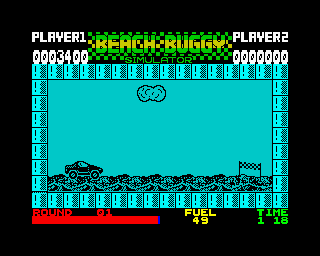
The first minutes of Beach Buggy Simulator are busy in the right way. You are not simply holding speed through a scrolling dune run: rocks and fire need to be jumped, helicopters need to be shot before they cause a crash, and the countdown refuses to let you settle into a comfortable rhythm. It has the immediate, slightly frantic pull of an arcade cabinet, where surviving the next few seconds matters more than planning several minutes ahead.
Fuel is the pressure point that gives the races their bite. You must grab canisters to replenish it and preserve your speed; hit empty and the buggy slows down until you recover one, costing precious time. Empty fuel also leaves you unable to fire, which can make a bad stretch snowball when helicopters are around. That overlap between racing, obstacle avoidance, shooting, and fuel management is the game’s strongest idea, because a canister is never just a pickup—it can be the difference between staying in control and watching a round slip away.
There are eight rounds, each with a time limit, and clearing all of them sends you back to round one. That makes Beach Buggy Simulator a score-chasing endurance game rather than a journey with a final ending. The hard edge is that failing one timed round ends the entire game. You will either enjoy learning how aggressively to push through each course, or resent being sent back after a late mistake. Give it a chance if short, repeatable challenges and unforgiving arcade rules sound energizing; skip it if you need a more forgiving sense of progress.
Graphics
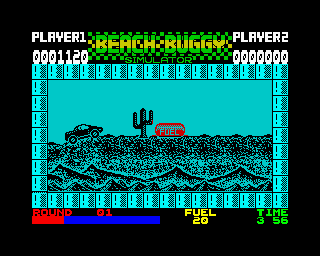
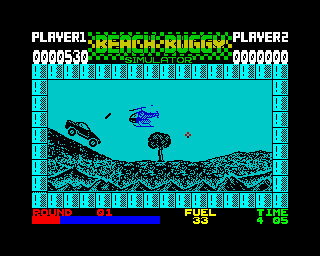
The action uses a 2D side-scrolling view, with the beach buggy racing across dune routes while rocks, flames, fuel canisters, and helicopters demand attention. It is a direct arcade layout: you watch the road ahead, pick out incoming hazards, and react quickly.
Story
The Dune Trials provide a simple competitive frame: your buggy is trying to survive and advance through eight rounds. That is enough to put the timer and the hazards in context, but the game is built around the run itself rather than dramatic buildup.
Its most effective “story” moments come from the little reversals generated by play. A clean stretch can turn desperate when fuel dries up, while a last-second canister can put the buggy back in contention. The helicopters add a hostile edge to what might otherwise be a straightforward off-road time trial.
Because a completed eighth round loops back to the first, the narrative shape is circular. You are chasing mastery and another chance to extend the run, not a grand resolution. That suits the compact arcade format, though it gives the game limited pull once the basic challenge has been understood. For game-specific release and history details, see Beach Buggy Simulator’s reference page.
Overall Experience
Beach Buggy Simulator has a solid arcade instinct: make every resource matter, make every collision hurt, and make the timer turn routine driving into a scramble. When you are low on fuel, coming up on a hazard, and trying to keep a helicopter from ruining the run, its mix of concerns clicks into a focused little test.
Its limits are equally clear. Eight rounds that loop indefinitely and instant failure on a missed time target make repetition central to the experience. There is satisfaction in steadily getting farther, but not much room for a relaxed or exploratory style of play. The game asks you to accept its severity from the start.
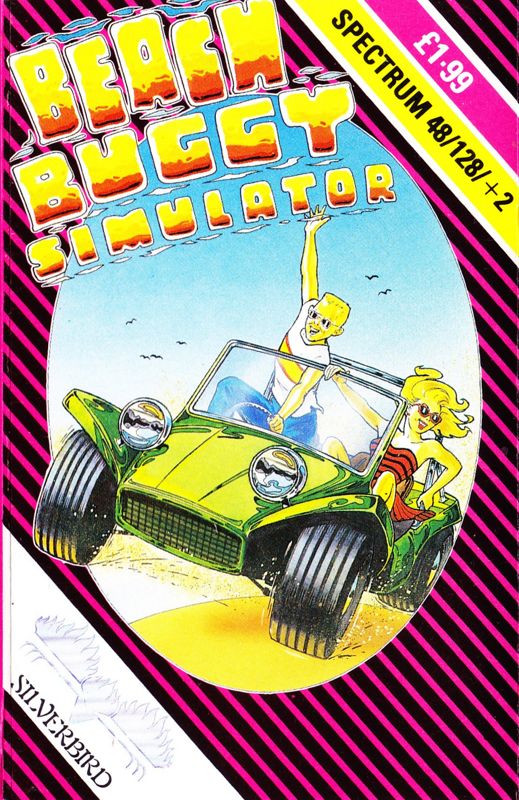
As a 1988 Commodore 64, ZX Spectrum, and Amstrad CPC arcade racer, it is worth a look for fans of demanding side-view driving games with a shooter wrinkle. The fuel-and-firepower connection gives it more tension than a plain time trial, even if the harsh restart rule and looping structure keep it from becoming a broadly inviting one. It is a decent, occasionally sharp diversion rather than an essential dune racer.


Reviews
There are no reviews yet.