 Retro Replay Retro Replay gaming reviews, news, emulation, geek stuff and more!
Retro Replay Review
Gameplay
Desert Fox is at its strongest when the campaign map has you feeling one step behind. Rommel’s attacks threaten several Allied depots, and you cannot simply sit back and solve the whole war at leisure. You move Lone Wolf across an overhead map, trying to reach trouble before it becomes irreversible. That ticking-clock structure gives even simple movement real weight: every detour can hurt, yet charging ahead blindly is hardly safe either.
The radio intel is a smart wrinkle because it lets you trade a little certainty for better routing. Use it to identify obstacles ahead, then decide whether the direct road is worth the likely interruption. The single airstrike is even more important. Since you get only one for the entire game, it is not a routine attack button but an emergency delay tool for a threatened depot. Saving it too long can be as costly as firing it too early.
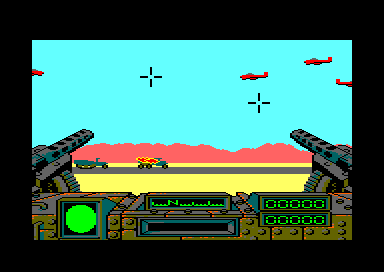
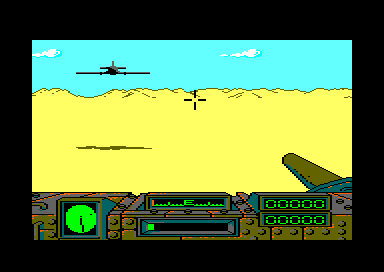
When you hit an obstacle or Rommel himself, Desert Fox changes gears into one of five action sequences: tank duels, turret defense against incoming fighters, minefield navigation, convoy protection, and ambush escapes. This makes the campaign feel less like moving counters around and more like commanding a vehicle through a hostile theater. The variety is welcome, although it also means you need to be ready for different kinds of pressure instead of mastering one repeated challenge.
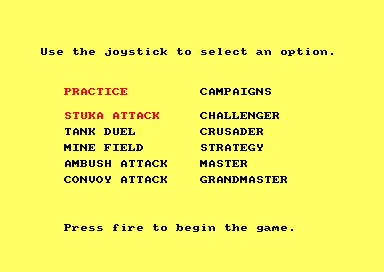
You can also play those action sequences outside the campaign, which is useful both for practice and for a quick session when you do not want to commit to the larger depot-saving mission. Still, the separate modes lack the campaign’s best ingredient: the consequence of knowing a mistake in one encounter can cost you precious time elsewhere.
Graphics
The overhead map gives you a clear view of Lone Wolf’s position, Rommel’s position, and the depots at the center of the campaign. During combat, the game switches to action-focused views suited to the particular encounter rather than staying on that map.
Changing lighting conditions across the day add some atmosphere to the North African campaign. It is a small touch, but it helps the repeated push across the desert feel less static.
Story
This is a straightforward World War II setup: as tank commander Lone Wolf, you are trying to derail Rommel’s plans in North Africa by preserving the Allied depot network. Desert Fox does not need a complicated dramatic framework because its urgency comes from the battlefield problem placed in front of you.
Rommel works well as a persistent opposing force because his position matters directly on the map. He is not merely a name attached to the setting; he is part of the pressure that shapes your choices, alongside the advancing attacks on the depots.
The result is a war-game story told through priorities rather than lengthy exposition. If you enjoy campaigns where the narrative comes from barely arriving in time, choosing which danger to address, and seeing whether your plan holds together, Desert Fox has a focused hook.
Overall Experience
Desert Fox earns its reputation as an unusual action-strategy blend by making both halves matter. The map layer establishes the larger problem, the encounters test your execution, and the limited airstrike prevents you from treating every crisis the same way. The first hour has a strong pull because you are learning how quickly a manageable situation can turn into several competing emergencies.
Frustration can set in when time slips away and you realize a poor route or badly timed intervention has put a depot beyond reach. That harshness is central to the design, though, not an incidental inconvenience. Success feels earned precisely because the game asks you to plan under uncertainty and then perform when the plan hits resistance.
Give Desert Fox a chance if you want an older war game with a genuine sense of momentum rather than a slow, purely strategic campaign. Its action scenes are more than decoration, and its strategic map is more than a menu between them. The payoff is a compact World War II command experience that keeps forcing meaningful decisions.

Reviews
There are no reviews yet.