 Retro Replay Retro Gaming History, Reviews & Emulation
Retro Replay Review
Gameplay
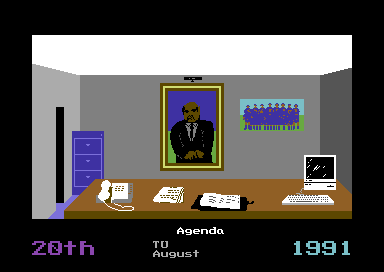
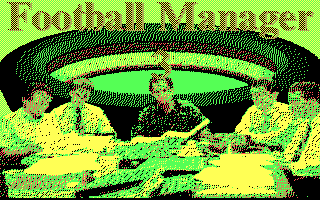
Football Manager 3 starts with a wonderfully specific fantasy: you are in the office, not on the pitch, and every match is an exam on the choices you made beforehand. You reach the game’s options by clicking around that visualised office, then get down to the essentials—selecting a lineup, setting tactics, and deciding how each footballer trains. It is an immediately understandable loop, and it puts the emphasis where a football management game should: judging players and living with the consequences.
The strongest part is its focus. Each athlete has statistics that affect how he performs, so selection is not merely filling positions with names. Individual training adds another useful layer of responsibility, giving you a reason to think about the squad member by member rather than treating the team as one interchangeable block. When you like tinkering with combinations and trying to squeeze more from a limited group, that concentration on the sporting side can be genuinely absorbing.
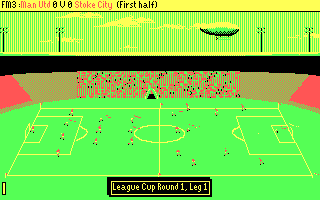
Matches are viewed from either a top-down angle or a slightly angled side view, and neither scrolls. With small player icons representing the action, you are watching for the broad outcome of your preparations rather than enjoying a richly detailed football spectacle. That can make the game feel blunt: it asks you to trust the underlying statistics and tactical choices, then offers a stripped-back depiction of their result. For some, that is the right old-school abstraction; for others, it will make bad results feel difficult to diagnose.
Frustration also sets in if you want the whole club-management package. Buying and selling players is where most of the financial game lives, so there is far less to chew on away from the team sheet than in more expansive management sims. Football Manager 3 is better when you treat it as a concentrated tactics, training, and transfer challenge. The related Football Manager 2 is worth a look if you are tracing the series’ earlier approach.
Graphics
The office interface gives the menus a little context, turning routine management decisions into clicks around a manager’s workspace. On match day, the view is much plainer: small footballer icons move across a non-scrolling field from above or from a shallow side angle. The top-down option is the clearer fit for following the shape of play; the side-on view offers a different perspective without adding much visual detail.
Story
There is no authored football drama here. Your story comes from running a British club through the practical cycle of choosing a side, working on players in training, entering the transfer market, and hoping the next match vindicates you.
That leaves room for the personal narratives management games do well: a statistical gamble in the lineup, a player developed through individual training, or a transfer that changes the balance of the squad. The game does not need a scripted plot to create tension, but it also does not dress those moments up. You bring the attachment to your club and its results.
If you enjoy inventing the stakes yourself, the spare framework is enough to keep a season moving. If you need character scenes, rivalries, or a campaign with a written arc, Football Manager 3 has little interest in supplying them.
Overall Experience
Football Manager 3 has a solid managerial core, but it is narrow and decidedly old-fashioned. The opening hour can hook you because the chain from player stats to training, team choice, tactics, and match result is easy to grasp. It knows what it wants you to care about: whether your football judgment is better than the last result suggests.
The payoff is worthwhile when you accept that narrow frame. You can spend satisfying time refining a squad and reacting to what the match views tell you, but the limited financial side and compact match depiction put a ceiling on how much texture the game can build. It is more of a focused football-management puzzle than a convincing all-purpose club sim.
Give it a chance if you enjoy vintage menu-driven sports strategy and can find pleasure in making a few consequential decisions well. Skip it if your ideal football manager game lives on detailed match analysis, elaborate finances, and layers of off-pitch administration. At 5.3, it lands as a competent but modest entry: a game with a worthwhile central loop, not one with enough depth around it to become essential.


Reviews
There are no reviews yet.