 Retro Replay Retro Gaming History, Reviews & Emulation
Retro Replay Review
Gameplay
Think! starts from the comforting promise of four-in-a-row and quickly turns it into a much meaner puzzle. You and your opponent alternate placing counters on a 6×6 grid, aiming for horizontal, vertical, or diagonal lines of four. The catch is excellent: counters enter only from the bottom or the right, and each insertion pushes the entire row or column along. You are never just placing a piece. You are rearranging the board and gambling on what survives the shove.
That makes the first few matches pleasantly disorienting. A line that seems safely built can be broken by a push from the other direction, while a counter reaching the far edge can be forced off the board and lost. You need to watch immediate wins, obvious blocks, shifting diagonals, and the possibility that a supposedly defensive move creates an opening somewhere else. Once that starts to click, ordinary Connect 4 feels almost static by comparison.
The downside is that Think! can be unforgiving. Because every move changes a full line, it is easy to miss the consequence that matters most until your opponent turns it into a winning four. That is less likely to frustrate you if you enjoy studying positions than if you want a breezy game of chance and simple pattern matching. The tutorial mode is especially valuable here: computer feedback and a percentage score give you a concrete way to see whether your instincts are improving.
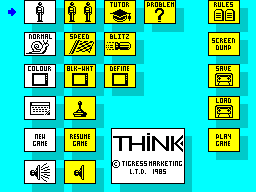
There is useful variety around the central rules. Speed Think! puts a limit on each move, while Blitz Think! makes you manage one overall time allowance; both should make familiar positions feel much more dangerous. Six preset problems offer compact tactical exercises, and the ability to create your own problems gives committed puzzle fans a reason to keep testing ideas after they have learned the basics. Local two-player matches remain the cleanest way to appreciate how much pressure a single shove can create.
Graphics
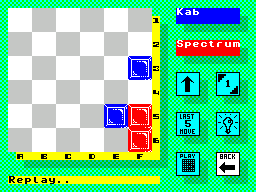
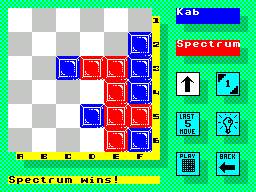
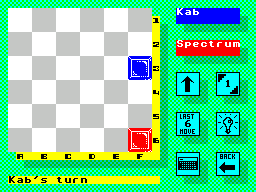
Think! is built around a fixed, top-down board view, so the important picture is the 6×6 grid and the counters being shifted through it. That direct layout suits a game where you must track rows, columns, diagonals, and pieces in danger of being pushed away.
Story
Think! finds its drama in the board position rather than a written tale. Each match creates a small contest of threats and reversals: you spot a possible line of four, your opponent shifts the board to spoil it, and suddenly the counter you thought was useful is one push away from disappearing.
The preset problems give that tension a more deliberate shape. With counters already on the grid, you are dropped into a position that asks you to read what has happened and identify the best continuation. They turn the game from a simple competitive pastime into a series of little tactical stories with a question at the center: can you find the move?
The tutorial adds another kind of narrative, one about your own progress. Being told how strong a move was and receiving a percentage at the end gives losses and experiments some context. You are not merely playing another round; you are learning which pushes were purposeful and which only looked clever.
Overall Experience
Think! is a smart variation on a classic idea, and its central change is substantial enough to justify the whole game. Pushing counters from two edges and shifting complete lines turns a familiar four-in-a-row race into a contest of board control, timing, and tactical foresight. It feels easy to explain but much harder to play well.
You should give it a chance if abstract strategy games are your comfort food, especially if you like seeing a compact ruleset produce nasty decisions. The computer opponent, tutorial assessment, puzzle problems, and time-limited modes mean there is more here than waiting for a second person to sit down. They also let you choose whether you want a thoughtful position to untangle or a fast test of nerve.
It will not win over anyone who needs theme or spectacle to stay engaged; its pleasures are entirely in the changing geometry of the board. But for a player willing to look ahead and accept that every push can rescue, ruin, or erase a plan, Think! has real staying power. Its best moments arrive when you realize that the move you dismissed a turn ago was the key to everything.



Reviews
There are no reviews yet.