 Retro Replay Retro Gaming History, Reviews & Emulation
Retro Replay Review
Gameplay
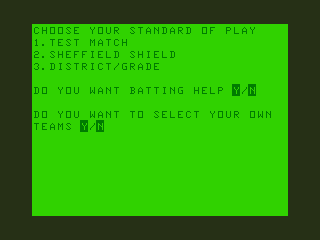
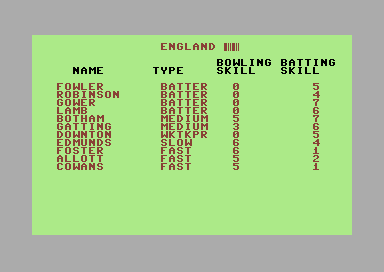
Tim Love’s Cricket starts with the decisions that make a cricket match feel like a match rather than a string of isolated shots. You can face a friend or the computer, select a side of your own or choose England or the Rest of the World, and make the call to bat or bowl after winning the toss. A sixty-over game is a serious commitment, so the opening choice has weight: batting first means setting the terms, while bowling first puts you immediately into the business of restricting runs and taking wickets.
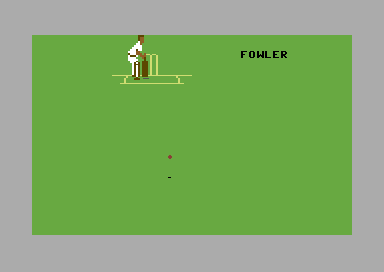
Bowling is where the game shows its ambition. From the elevated view behind the bowler and umpire, you control speed, direction and where the ball pitches. The six bowlers span fast, medium and spin options, with medium and spin bowlers also able to work swing or spin into the delivery. That gives you more to think about than simply aiming at the stumps. You are trying to make the batter commit to the wrong response, and the different bowling types invite a little experimentation before you settle into a reliable plan.
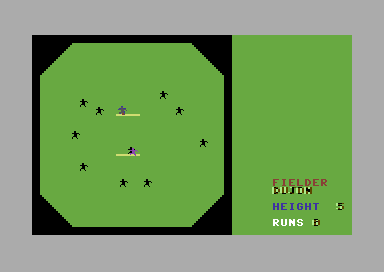
Once the ball leaves the hand, the viewpoint changes to put you in front of the batsman. Here you manage bat angle, bat height and your position on the crease, so batting asks for deliberate placement rather than a single automatic swing. A miss can still end safely if it avoids the stumps and LBW, while a hit sends the game into its top-down pitch view. Then comes the lovely cricket-specific hesitation: run, or stay put? Controlling the closest fielder after the ball is played makes that decision feel contested instead of ceremonial.
The three skill settings—Test, County and Village—are useful because this is a game built around several controls changing hands within one delivery. Village is the sensible place to learn the rhythm of bowling, batting and fielding; Test is where the full length and back-and-forth nature of the sixty-over format has the most room to breathe. The constant perspective changes demand some adjustment, but the payoff is a cricket game that lets you participate in nearly every phase of a ball.
Graphics
The game changes its camera to match the action: an elevated view behind the bowler and umpire for the run-up, an elevated front view of the batsman for the shot, and a top-down look at the pitch once the ball is in play. That last view is particularly useful, because you can see the fielders’ positions before deciding whether a run is worth the risk.
Story
There is no invented drama to carry Tim Love’s Cricket; its story is the scoreline you create over sixty overs. Winning the toss supplies the opening chapter, because your decision to bat or bowl determines which kind of pressure you take on first.
Every delivery can add a small turn. A carefully placed ball can force an awkward batting response; a well-judged shot can turn into a running decision; and the nearest fielder becomes central when the ball is loose. The game gets its tension from that sequence of cause and response.
Team choice gives the match a straightforward frame as well. You can take a custom-selected team into the contest, or choose England or the Rest of the World, then let the contest build its own momentum. It is sport-storytelling in the plainest, most satisfying sense: the memorable moments are the ones you earn.
Overall Experience
Tim Love’s Cricket is at its best when you accept its measured pace. This is not cricket reduced to one button and a highlight reel. It wants you to consider bowling variation, batting position, shot height, field placement and whether a risky run is actually on. For a game from 1985, that is a remarkably complete set of responsibilities to put in your hands.
Frustration is most likely to come from the handoff between views. You bowl from one angle, bat from another, then switch to the overhead pitch view for running and fielding, and that rhythm takes practice. Still, the switches are purposeful rather than decorative: each one corresponds to a new decision, and learning that cadence is where the game starts to click.
Cricket fans with patience for a full match should give it a look, especially if the sport’s tactical duel matters more to you than immediate action. The long format, adjustable difficulty and ability to play against another person give it staying power. It is a demanding little simulation of cricket’s shifting responsibilities, and its payoff is the satisfaction of shaping a match ball by ball.



Reviews
There are no reviews yet.