 Retro Replay Retro Replay gaming reviews, news, emulation, geek stuff and more!

Retro Replay Review
Gameplay
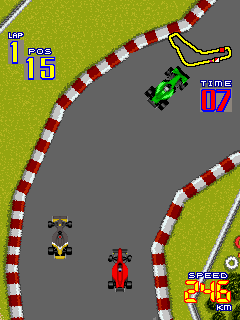
F-1 Grand Prix is at its best when you stop trying to muscle your way around the track and start driving with a little restraint. From the first few laps, the top-down viewpoint turns racing into a tight exercise in positioning: you are reading the road ahead, threading through traffic, and trying not to spoil a run with a careless collision. It has the direct, pick-up-and-play energy of an arcade racer, but it asks for more composure than its simple perspective initially suggests.
The damage system is the feature that gives the racing real teeth. Collisions weaken the car’s components, and ignoring that punishment can end a race early; a pit stop to make repairs is often the sensible choice. That creates a useful tension in every aggressive move. You can push harder, but you cannot simply bounce off trouble and carry on as if nothing happened. For a game built around short, repeatable races, that consequence keeps the driving from becoming completely disposable.
Manual tuning adds a welcome layer for anyone who likes preparing a car as well as steering it. The game does not need a long event to get going, either: a single race is ideal for a quick run, while best lap competition distills the challenge into finding cleaner lines and carrying speed more effectively. The full Grand Prix is the mode to choose once the handling has started to click and you want the season-based structure to give your results more weight.
Frustration arrives when small mistakes pile up. A collision is not merely lost momentum; it can become damage, a repair stop, and a compromised result. That can feel harsh if you come in wanting loose, consequence-free arcade chaos. If you enjoy the pressure of protecting a race rather than merely surviving it, though, F-1 Grand Prix has a satisfyingly stern streak.
Graphics
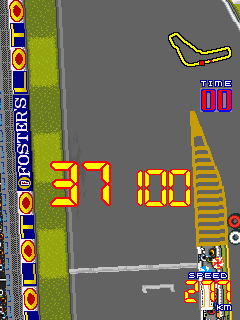
The racing is shown from above, with 2D scrolling circuits keeping the route and nearby cars in view. During a lap, the car remains still while the environment rotates around it, an unusual effect that makes the course feel like it is turning beneath your machine. It is a functional way to follow the action, especially when the focus is on maintaining a neat line rather than admiring the scenery.
Story
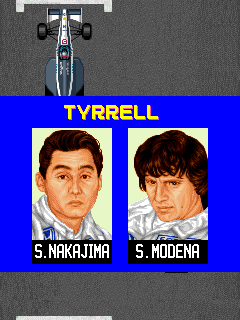
There is no character-led tale to carry you from race to race. The 1991 Formula One season is the game’s framework instead, giving the Grand Prix mode a licensed championship context rather than a fictional rivalry or campaign plot.
That suits the game’s priorities. Progress is measured in races, laps, tuning choices, damage, and whether you can keep a car intact long enough to finish well. The drama comes from a result slipping away after contact or from recovering after a repair stop, not from scripted scenes.
If you want motorsport atmosphere without a narrative detour, the season framing does enough. If you need a racing game to build personalities and plot around its events, this one stays firmly focused on the circuit.
Overall Experience
F-1 Grand Prix is a solid, slightly severe top-down racer whose best idea is making contact matter. The combination of tuning, component damage, and repair stops gives its races more consequence than a simple chase for first place. Once you accept that clean driving is part of the challenge, its compact format starts to feel purposeful.
Its limitations are equally clear. The rotating-track approach is distinctive, but the game lives or dies on whether you enjoy repeatedly refining laps from this overhead view. There is not much room here for someone looking for a lavish racing career or a story-driven season. You are here to learn circuits, protect the car, and chase a better run.
At 6.3, it lands as a worthwhile curiosity rather than a must-play racer. Give it a chance if you like old arcade racing with consequences and enjoy turning a rough first attempt into a tidy, controlled lap. For a later, more simulation-minded take on the sport, you can also compare its compact approach with Grand Prix 3.


Reviews
There are no reviews yet.