 Retro Replay Retro Gaming History, Reviews & Emulation

Retro Replay Review
Gameplay
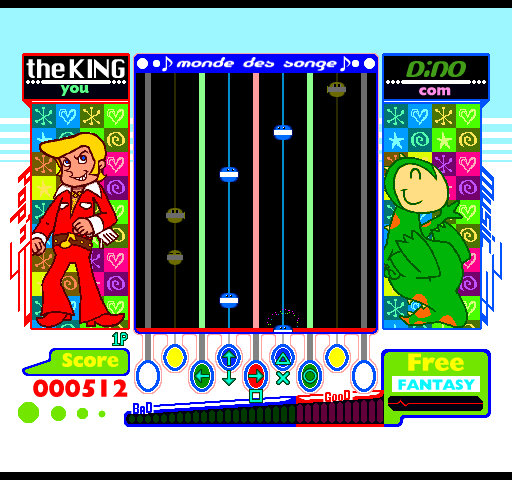
The first few songs make pop’n music feel disarmingly approachable. Notes scroll toward the bottom of the screen, you match them on the big colored buttons, and the music immediately tells you whether your hands are keeping up. There is no clutter around that central exchange. You press in time, build the groove meter by playing cleanly, and try not to let mistakes drain it before the song ends.
What starts to click is the physical logic of the nine-button layout. It is a clear break from beatmania: no turntable, no keyboard-style arrangement, just a broad row of buttons asking your hands to cover more ground. That makes the challenge easy to understand but not necessarily easy to conquer. A chart can turn from comfortable to hectic as your attention shifts between timing and reaching the correct button, and a dropping groove meter adds real pressure to every missed note.
Newcomers should begin with the training or beginner options rather than treating all nine buttons as a test of pride. The five- and seven-button arrangements let you learn the timing without immediately being stretched across the entire controller. Once that feels natural, the full layout offers the more satisfying version of the game: a straightforward rhythm challenge where improvement is obvious, because better timing directly keeps you in the set.
Arcade mode supplies the needed stakes. You are not merely chasing a better feel for a track; you need a high enough groove meter at the end to continue onward. That pass-or-fail structure can frustrate when a song slips away late, but it also prevents the session from becoming passive button tapping. pop’n music wants you locked in, listening closely, and earning the next selection.

Graphics
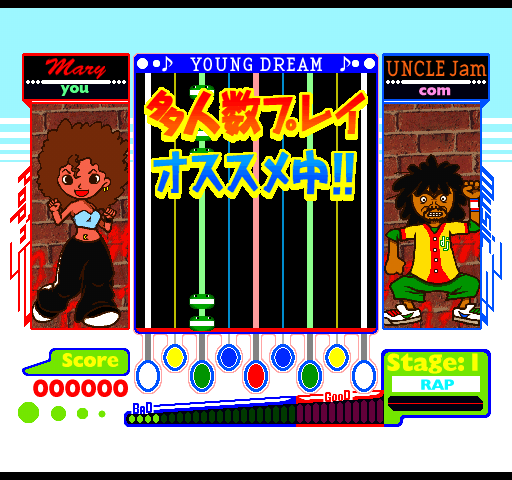
The game’s most memorable visual touch is right in its control concept: nine large, candy-colored buttons. On screen, descending notes travel toward the bottom target area, giving you a clean view of what needs to be hit and when. It is a bright, uncomplicated look that fits a game built around immediate rhythmic response.
Story
pop’n music does not lean on a narrative hook; its momentum comes from moving through songs and keeping the groove meter high enough to advance. That puts the focus squarely on your performance rather than on any detour between tracks.
In practical terms, each song becomes its own tiny dramatic arc. You begin by finding the beat, settle into the pattern, then either hold your nerve as the meter rises or scramble to recover when misses start costing you. It is a simple structure, but rhythm games often need little more.
The original arcade music is joined by several new original tracks in this release, so the journey has more variety than a bare conversion. The important story is the one your hands write: the songs that initially knock you out, then gradually become the ones you can clear with confidence.
Overall Experience
pop’n music is easy to recommend if you want a rhythm game that gets to the point. Its button layout looks playful, but the groove-meter requirement gives every track consequence, and the jump from reduced-button beginner play to the full nine-button setup gives you a sensible learning curve. The payoff is not a complicated campaign; it is the deeply satisfying moment when an awkward pattern finally starts feeling natural.
It is especially inviting for anyone put off by beatmania’s turntable. Here, the relationship between note and input is immediate, so you can spend more energy on rhythm and less on deciphering the controller. That accessibility should not be mistaken for softness, though. Keeping a performance strong enough to continue can make the tougher songs feel unforgiving in exactly the way an arcade rhythm game should.
Give it a chance if you enjoy chasing cleaner runs, learning songs through repetition, and feeling your fingers gradually catch up to your ears. Start with the beginner settings, move into the full layout when ready, and let the game’s cheerful simplicity reveal its bite. For broader background on the series, see the Pop’n Music series history.


Reviews
There are no reviews yet.