 Retro Replay Retro Gaming History, Reviews & Emulation
Retro Replay Review
Gameplay
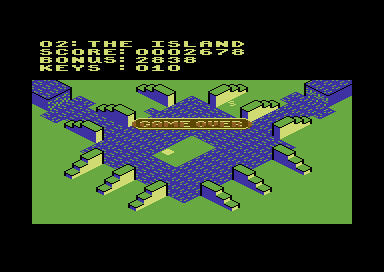
The first few stages ask a simple question: can you read an isometric room quickly enough to grab every key and get away from whatever is chasing you? That directness is Lode Runner’s Rescue‘s strongest quality. You run, jump, and swim through a compact series of screens, and every level has a clear finish line: collect all the scattered keys. There is little mystery about what you should be doing, which lets the tension come from execution.
The diagonal-down viewpoint makes this a sharp break from the earlier Lode Runner. This is not a game about recreating that series’ usual rhythm; it is an isometric action game that borrows the name and turns each level into a route-planning problem. Enemies do not need complicated behavior to be troublesome. Because you simply need to avoid them, the pressure comes from finding safe paths while keeping track of keys you still need.
The three-life limit gives each slip real weight. Losing all three sends you back to replay the level, which can turn a close attempt into a frustrating reset, particularly when a course has already made you work for its last few keys. Yet that harshness also gives successful runs some bite. The 46-level campaign has enough room for the format to test your patience, and the icon-based editor is a meaningful extra for anyone who enjoys building fresh courses rather than only conquering the supplied ones.
Graphics
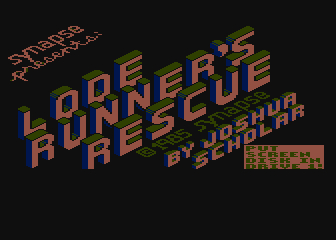
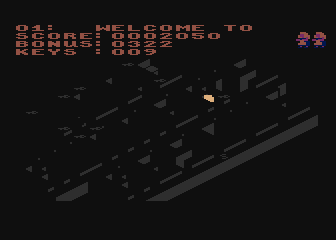
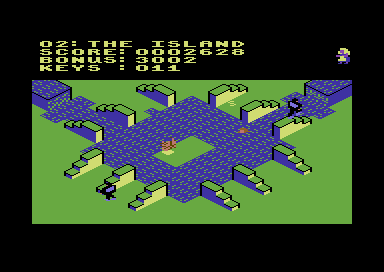
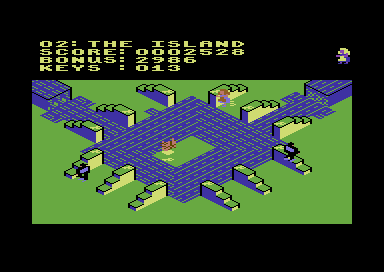
The game uses an isometric, diagonal-down view reminiscent of Crystal Castles. That angle is central to what you see and do: rooms are viewed from above at a slant, with the heroine, keys, and roaming enemies sharing the same compact play space. It makes the game look distinctly different from the side-on image many people associate with Lode Runner.
Story
The story is lean but functional. Lode Runner has been captured by the Bungeling Empire while trying to recover stolen treasure, and his daughter takes over the rescue. It is a clean excuse to put a new lead at the center of the action, not a tale that competes with the levels for attention.
That change of protagonist matters more than the kidnapping itself. Calling the game Lode Runner’s Rescue could suggest another outing for the usual hero, but you are guiding his daughter through the danger instead. The rescue framing gives the key hunt a little purpose without bogging an action game down in explanation.
If you want release and history details, the game’s Lode Runner’s Rescue history is useful context. In play, though, the plot stays where it belongs: in the background, while the next key and the nearest enemy demand your attention.
Overall Experience
Lode Runner’s Rescue is an interesting detour rather than an automatic recommendation for every fan of the name. Its isometric perspective, jump-and-swim movement, and enemy-dodging give it a different character from the classic formula. If that sounds like a betrayal of what you want from Lode Runner, it probably will be. If it sounds like a curious 1985 action puzzler, there is real value in its focused stages.
The rough edge is the life system. Three lives can make a difficult level feel exciting when you are close to the finish, then aggravating when a final mistake demands a full replay. You need to enjoy repetition as part of mastering a course. The game is more rewarding for the stubborn, score-chasing mindset than for anyone looking for a relaxed treasure hunt.
The editor helps the package outlast the 46 built-in levels. It cannot erase the frustration of resets, but it gives you a reason to keep thinking about how these spaces work after you have seen the campaign. Give it a chance if you like old-school action games that are clear, compact, and unapologetically demanding; skip it if you only want the familiar Lode Runner experience.


Reviews
There are no reviews yet.