 Retro Replay Retro Gaming History, Reviews & Emulation
Retro Replay Review
Gameplay
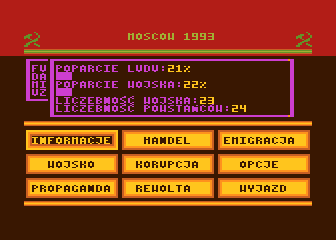
The first pull in Moscow 1993 is the uncomfortable clarity of its central loop. You begin in 1991 with an opposition movement but without the funds to make that opposition matter. Speculative trade in illegal goods across Soviet cities becomes the engine for everything else. Make money, then decide whether it is better spent on an army, on generals, or on propaganda. That is a solid strategy-game premise because every successful deal immediately creates another hard choice.
The game does not let you treat money as a score to hoard. Cash is political and military potential, and the three stated uses pull in different directions. Bribing generals may sound essential when you are thinking about a future showdown; propaganda matters when you need wider influence; building an army is the most direct expression of your goal. You are asked to balance those priorities over two years and ten months rather than simply chase the largest possible bankroll.
That deadline is where the tension should either hook you or wear you down. A long strategic plan has to start early, yet investing too soon can leave insufficient funds for the other pillars of the campaign. Moscow 1993 is consequently more interesting for gamers who like planning under a fixed clock than for anyone who wants to freely experiment without consequences. Its trading focus also means you should come for economic maneuvering first, not a conventional battlefield strategy experience.
Graphics
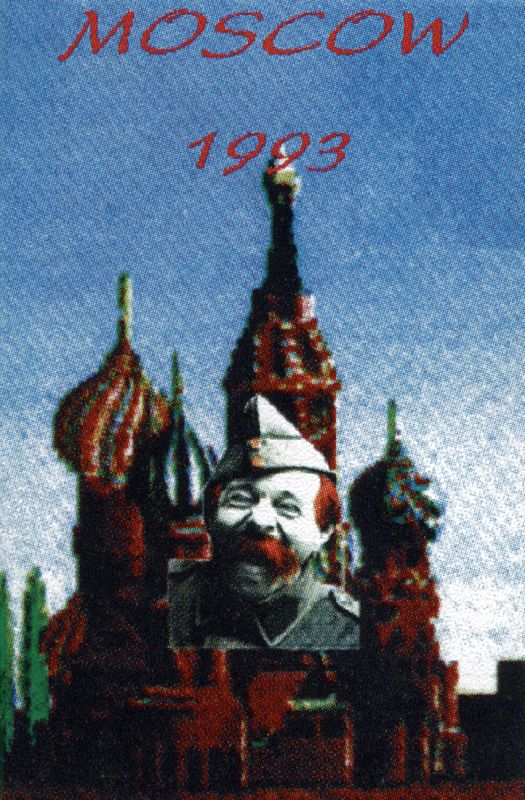
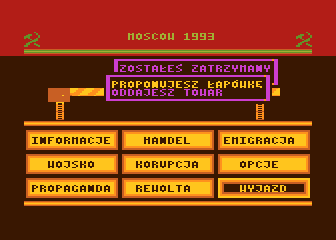
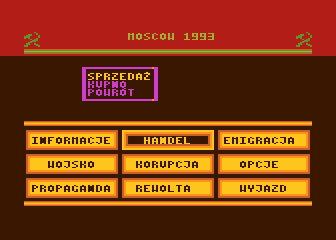
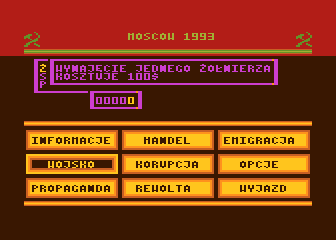
Moscow 1993 is an Atari 8-bit strategy game, and its stated design centers on moving between Soviet cities, trading, and directing funds toward a political objective. The game’s strongest imagery comes from that stark scenario rather than decorative spectacle: cities are places to exploit for profit, while armies, generals, and propaganda are resources in a dangerous campaign.
Story
This is not a detached fictional war story. Moscow 1993 puts you in the role of opposition figure Ruslan Chasbulatow and asks you to overthrow communism in the Soviet Union. Beginning in 1991, it frames the next two years and ten months as a race to transform an underfunded opposition into a force capable of taking power.
The premise is deliberately severe. Illegal goods are not flavor text around the campaign; they are the main source of funding for bribery, propaganda, and armed strength. That makes the game’s politics feel transactional in a way that will interest some strategy fans and repel others. It is a story of power built through compromise and coercion, not a heroic liberation fantasy.
Because the goal is so specific, Moscow 1993 has a focused narrative drive even without needing elaborate plot beats. Each financial decision feeds the same escalating question: have you built enough influence and force before time runs out? If you enjoy historical-political games that make their subject matter central to the play rather than merely using it as a backdrop, that focus is the main reason to investigate it.
Overall Experience
Moscow 1993 earns attention for refusing the usual comfort zone of strategy games. Its core challenge is not simply winning battles or accumulating territory; it is converting risky commerce into the connected forms of power needed to challenge a regime. That creates a compact, purposeful structure in which trading has consequences beyond the balance sheet.
There is also no getting around how specialized it is. The political objective, the role you inhabit, and the reliance on illegal speculation make for a cold, ethically abrasive game. If you want a broad simulation with room to define your own aims, this is likely too narrow. If you can accept its premise, the narrowness gives it urgency: every resource has a job, and the calendar keeps moving.
Give it a chance if you enjoy strategy games where a plan must survive competing investments and a hard deadline. The payoff is the sense of assembling a campaign from fragile financial beginnings, one bribe, propaganda effort, and military investment at a time. It is an obscure, demanding idea rather than an easy recommendation, but its blend of trade and political ambition is distinctive enough to merit a look.


Reviews
There are no reviews yet.