 Retro Replay Retro Gaming History, Reviews & Emulation



Retro Replay Review
Gameplay
The first few seconds of Pogo Joe are wonderfully direct. You bounce from barrel to barrel on diagonal paths, changing each one’s color, and your goal is to convert the whole arrangement before the enemies make the board too dangerous. It has that old arcade quality where the rule is clear almost immediately, but a clean clear takes more thought than you expect.
Comparisons to Q*Bert are fair, yet Pogo Joe does more than swap cubes for barrels. Levels do not have to follow a simple pyramid shape, so you cannot rely on one familiar route pattern. Barrel properties also vary, which adds little tactical wrinkles to what could otherwise be a straightforward repainting exercise. You start looking ahead: which barrel should be saved for later, where can you safely land, and which section will become awkward once enemies close in?
The super jump is the key change to the usual cornered-on-an-isometric-board feeling. It gives you an emergency option when a normal bounce would send you into trouble, while certain barrel colors can clear enemies from the screen entirely. That makes survival less rigid than in some contemporaries, but it does not make the game easy. The pressure comes from deciding whether to spend your escape now or keep moving and hope your route stays open.
That tension is also where frustration can creep in. Pogo Joe is built around constrained movement and fast consequences, so mistakes can feel expensive. Still, the game earns its difficulty because the board layouts and special barrel behavior ask you to adapt rather than simply repeat a memorized pattern. Give it a little patience and the initially simple hopping starts to feel like a brisk, mean little puzzle.

Graphics
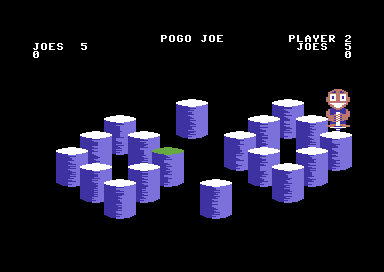
The action is shown on fixed isometric boards, with Joe hopping across chunky barrels instead of Q*Bert-style cubes. That barrel-based look is the game’s most distinctive visual touch, and the different level shapes help each screen avoid looking like the same pyramid rearranged.
Color changes matter because they are the whole objective: you can see your progress spread across the board as more barrels convert. Enemies share that compact arcade stage, keeping your attention on safe diagonals and rapidly shrinking space.
Story
There is no elaborate story pulling you through Pogo Joe. You are here for the next board, the next dangerous route, and the satisfaction of changing the last remaining barrel before an enemy ruins the attempt.
That stripped-down approach fits the game. It never asks you to care about a grand quest; its personality comes from the odd sight of a character pogoing across barrel formations and from the escalating trouble on each compact screen.
If you need characters, plot turns, or a sense of world-building to stay invested, this will feel thin. Pogo Joe treats context as a wrapper for arcade action, and it is honest about that from the moment you begin.
Overall Experience
Pogo Joe is an energetic variation on a famous arcade template, not a wholesale reinvention of it. The basic loop remains instantly recognizable, but alternate board shapes, varied barrels, the super jump, and enemy-clearing opportunities create enough room for its own decisions and recoveries.
Its best moments arrive when you stop hopping reactively and begin reading the whole board. A barrel that looked like one more square to convert becomes an escape route, a future obstacle, or the timely way to wipe enemies away. That shift from reflexes to route management is the payoff, and it gives the game more staying power than its simple objective suggests.
Try it if you enjoy early arcade games that demand concentration in short bursts and make every movement count. You can find broader game history and release information in this Pogo Joe overview, but the practical verdict is simpler: it is a solid, sharp-edged alternative when you have exhausted the obvious Q*Bert-style score-chasers.


Reviews
There are no reviews yet.