 Retro Replay Retro Gaming History, Reviews & Emulation



Retro Replay Review
Gameplay
DeathStar starts with the kind of immediate arcade problem that is easy to understand and hard to manage cleanly. You pilot a ship that is always moving forward, turn it through sixteen directions, fire at targets, and hunt down planetoids for crystals. Those crystals become points and, more importantly, starbombs. That creates the whole game’s tension: you are never merely clearing the screen, because every moment spent gathering ammunition is part of a race against the enemy.
The workers make that race feel properly mean. They chase released crystals and haul them back to the DeathStar, while warriors can attack you directly. Shooting a worker carrying a crystal lets you steal it back, so a crystal can become a tiny tug-of-war in the middle of the wider chase. Collisions do not hurt your ship, which keeps the focus on positioning, firing, and collecting rather than nervously avoiding every object. The radar near the top of the screen is essential rather than decorative; learn to glance at it constantly if you want to keep track of threats and the approaching target.
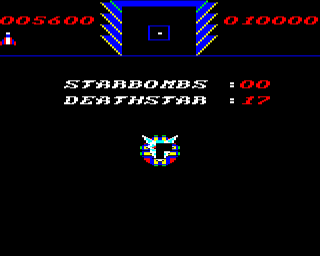
Once the workers have delivered twenty crystals, the DeathStar appears, pursues you, and demands the ammunition you have been building. Regular shots cannot damage it, so this is where inefficient mining catches up with you. Starbombs home in on its position and can be fired one after another, making the attack thrilling when you have stocked up, but a scramble when your supply runs dry. Destroying all twenty pieces brings a big bonus and warps you to the next zone. The changing Worker, Warrior, Planetoid, and Void zones keep the familiar loop under pressure, especially when fewer planetoids leave less room to rebuild your bomb supply.

Graphics
The BBC Micro action is viewed from the side against an endlessly scrolling space backdrop. Planetoids, workers, warriors, crystals, your ship, and the DeathStar give the screen a clear set of targets, while the glowing crystals stand out as the things you need to grab. The small radar uses white, blue, and red dots to separate your ship, warriors, workers, and the DeathStar at a glance.

Story
DeathStar does not need a complicated setup to create stakes. You are in hostile space, trying to arm yourself from the field before enemy labor feeds a massive warship. That basic conflict is clear the instant workers start carrying away crystals you wanted for yourself.
The game’s drama comes from escalation rather than scripted scenes. At first, the DeathStar is an off-screen consequence of the workers’ success; then it arrives as an active pursuer guarded by warriors. The shift turns routine resource gathering into a direct survival test.
Each destroyed DeathStar sends you through a warp drive toward another zone, giving the campaign a brisk forward push. Bonus screens between zones mark the transition, but the real narrative payoff is earned in play: you have survived the enemy’s buildup and turned its own race for crystals into your ammunition.
Overall Experience
What makes DeathStar worth playing is the way its simple rules keep producing pressure. Mine planetoids too cautiously and the workers get ahead. Focus too hard on warriors and you may have too few starbombs for the real fight. Chase every loose crystal and you can drift into danger. It asks you to make quick, practical decisions rather than simply pour shots into whatever is nearest.
The fixed forward movement and coarse turning steps give it an unmistakably old arcade feel. That can frustrate you at first, particularly when you need to line up shots or alter course in a hurry, but it also makes good control feel earned. You are not gliding freely through space; you are committing to a direction and recovering from that commitment under fire.
This is a strong fit if you enjoy tough, score-driven shooters where mastering the loop matters more than seeing a broad range of activities. Three lives and an enemy that can accelerate its own arrival make mistakes costly, yet the central cycle remains satisfying: break rocks, deny the workers, build a bomb reserve, and finally tear apart the ship that has been hunting you. For a compact 1984 arcade challenge, DeathStar has a sharp, durable hook.


Reviews
There are no reviews yet.