 Retro Replay Retro Gaming History, Reviews & Emulation
Retro Replay Review
Gameplay
Zalaga starts with a premise you understand in seconds: slide a ship across the bottom of a fixed screen and shoot aliens before their fire or their bodies reach you. That immediate clarity is its strength. You are not learning a complicated ruleset; you are learning the movement of each wave, judging gaps, and deciding whether to hold your ground or shift before a diving enemy makes your current position a bad one.
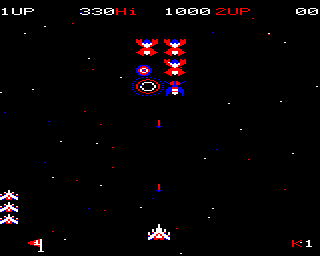
The formations give the action its pulse. Enemies are not merely parked targets, and their attempts to shoot or collide with you keep even familiar-looking waves tense. Clearing every alien to advance is satisfying precisely because it asks for control, not just constant shooting. A messy screen can turn into a clean finish if you stay calm, but one reckless move can throw away a strong run.
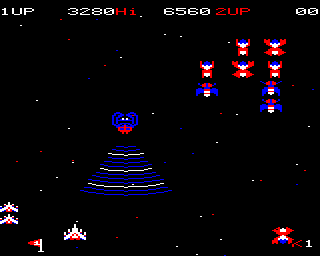
The tractor-beam threat is where Zalaga finds its most memorable bit of arcade drama. Letting a ship get captured is painful, yet destroying the captor and recovering it rewards you with two ships firing at once. That makes recovery feel like a comeback rather than a consolation prize, and the doubled firepower can change how confidently you attack the next formation.
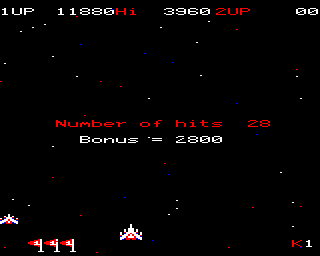
Challenge stages break up the regular levels with a more direct test of aim: enemies fly through a set pattern and you try to shoot down as many as possible. They are a welcome change of pace and a natural invitation to replay for a better result. One or two people can play, and keyboard or joystick support lets you use whichever control method feels more natural. The operator settings for automatic fire and reload speed also make the game easier to tune toward a preferred pace.
Graphics
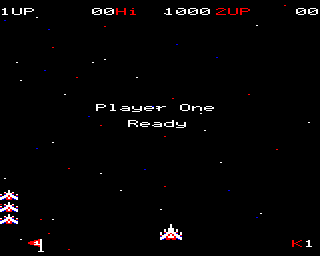
The view stays locked on the battlefield, with your ship skimming along the lower edge while alien formations occupy the space above. That simple layout makes danger easy to track: you can see the ranks, their dives, and the openings you need to shoot through without hunting around the screen.
Story
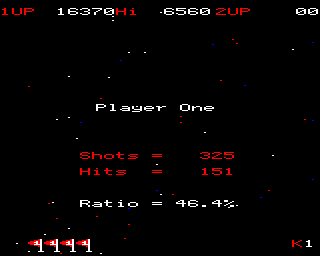
Zalaga is built around the immediate conflict of a lone ship facing waves of aliens, not around a developing plot. The lack of narrative detours suits its arcade focus: the stakes are clear the moment the first formation moves into place, and your next goal is always to survive long enough to erase the screen.
That stripped-back approach also keeps attention on the small stories a run creates for itself. A captured ship becomes a rescue attempt; a difficult formation becomes a test of nerve; a challenge stage becomes an opportunity to reclaim a score you know you could have pushed higher.
If you want character scenes or a campaign that unfolds between levels, Zalaga will not hold your interest for long. Its drama comes from the playfield: whether you can recover from danger, finish a wave, and make the next screen feel a little more manageable.
Overall Experience
Zalaga succeeds because it does not waste time getting to its best idea. Within the first minute, you are dodging formations, firing upward, and feeling the pressure of enemies that can attack from above or dive into your path. It is a familiar arcade formula, but it remains enjoyable when the movement clicks and you begin clearing waves with purpose rather than panic.
The Galaga-like foundation is both its limitation and its virtue. It is not trying to reshape the fixed-screen shooter; it relies on a proven structure and gets mileage from formations, challenge rounds, and the satisfying two-ship recovery. The frustration comes in the way a crowded screen can punish a lapse quickly, but that same sharp punishment makes successful recoveries feel earned.
Give Zalaga a chance if you like score-driven shooters where repeated attempts sharpen your instincts. The payoff is not a grand finale or a long list of surprises. It is that old arcade feeling of turning one more attempt into a cleaner, bolder run—especially when you manage to reclaim a captured ship and unleash twice the firepower.


Reviews
There are no reviews yet.