 Retro Replay Retro Gaming History, Reviews & Emulation
Retro Replay Review
Gameplay
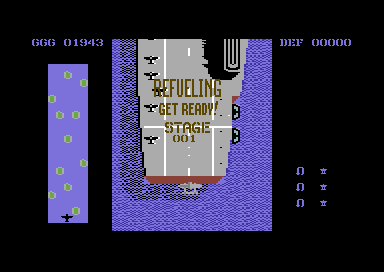
The first few minutes of ’43 – One Year After are exactly what you want from a 1942-inspired shooter: a carrier take-off, a P-38 Lightning, and an immediate rush into enemy-filled skies over the Pacific. You fly upward through a steady stream of Japanese aircraft, grab power-ups when they appear, and try to keep a clean line through incoming fire. There is no long warm-up period; it asks whether you can handle the fundamentals straight away.
What gives the game a little more personality than a bare clone is its defensive loop maneuver. Used well, it is a useful escape from a bad position, especially when enemy fire has closed off your normal routes. But you can only perform it three times, so it is not a move to burn the moment things get uncomfortable. Save it for the moments when your run is genuinely about to end.
That limited safety net also defines the frustration. You have three lives, three loops, and little room to casually absorb mistakes. The action can feel punishing when a crowded screen catches you without a clean exit, particularly if you have already spent your defensive maneuvers. Power-ups matter because they improve your odds, but they do not turn the game into a carefree power fantasy.
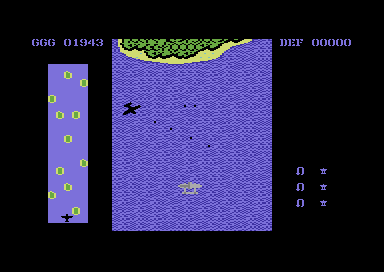
The progress map on the left is a welcome touch. It reminds you that you are advancing across a larger Pacific route rather than endlessly circling through disconnected waves. It is a small detail, yet it gives survival a destination and makes another successful stretch feel worthwhile.
Graphics
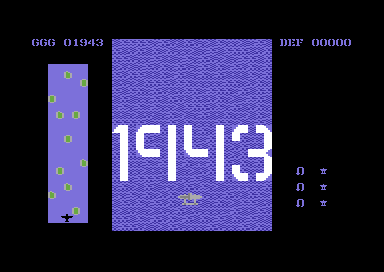
The game keeps the focus on the vertical battlefield: your Lightning climbs over island-dotted Pacific waters while Japanese aircraft enter the fight around it. The carrier take-off is a neat opening image, and the persistent map at the left makes your position in the campaign easy to check without leaving the action.

Story
This is a World War II shooting mission rather than a story-heavy campaign. You are a pilot in a Lockheed P-38 Lightning, fighting Japanese aircraft across the Pacific and pressing onward from one point on the map to the next.
The carrier launch and the island setting give the game a clear wartime frame from the start. They do enough to make the action feel like a journey through a theater of war instead of a completely abstract scoring exercise.
Do not come in expecting character drama or plot twists. The narrative payoff is your advance across the map: each stretch survived says you have pushed farther into the route despite the pressure in the sky.
Overall Experience
’43 – One Year After is built for the kind of shooter fan who enjoys earning every extra minute of a run. Its carrier start, Pacific setting, collectible power-ups, and defensive loop all give it more flavor than a totally anonymous vertical scroller, while the map offers a satisfying indication that you are getting somewhere.
Its weakness is also its point of pride: it is stingy. Three lives disappear quickly, and the three defensive loops demand restraint. If you want a shooter that lets you improvise recklessly, this can feel more irritating than exhilarating. If you enjoy learning when to hold position, when to chase a power-up, and when to spend your last-resort escape, the tension starts to click.
There is a worthwhile arcade challenge here, but it is a narrow one. The game leans heavily on its 1942-style foundation and does not cushion its difficulty with generous resources. Give it a chance if you want a compact Commodore 64 test of reflexes and nerve; skip it if repeated, hard-fought attempts sound more exhausting than exciting.


Reviews
There are no reviews yet.