 Retro Replay Retro Gaming History, Reviews & Emulation
Retro Replay Review
Gameplay
The first hour of Dark Empire is about learning to think from your one city outward. Your captured base is not merely a starting marker; it is where you train troops and produce air, land, and sea transport. That immediately gives expansion a logistical edge. You cannot simply admire a large map and expect territory to become yours. You need to decide what to build, where to send it, and how far you are willing to move away from the safety of home.
Orders are admirably direct: units outside the city can move, attack, or hold. In a turn-based war game, that small command set can be a strength. Holding ground matters because every unit pushed forward is also a unit that may be needed elsewhere, while attacking and exploring expose more of the planet. The limited visibility gives your advances a cautious, methodical rhythm. You see only explored areas, so each push into the dark asks you to commit before you know the full shape of the problem.
The interface is firmly of its time. You move a cursor around the overhead map with a joystick, then press fire on a city or unit to issue its next order. It is simple enough to understand, though it asks for patience rather than speed. Dark Empire will suit you if you like pausing over the board, checking your units, and making deliberate turns. If you want immediate action or lavish command options, its narrow, icon-driven approach may start to feel restrictive.
What keeps it interesting is the pressure between production and expansion. More troops and transports strengthen your position, but they also cost you turns in a war where the map is waiting to be claimed. The on-screen city total gives every turn a clear strategic measure. You are not chasing busywork; you are trying to turn one hard-won foothold into control of an entire world.
Graphics
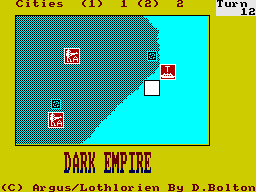
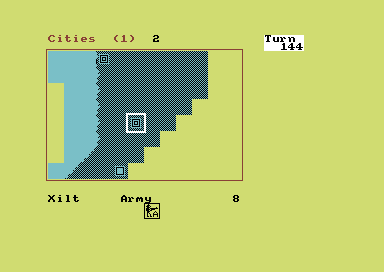
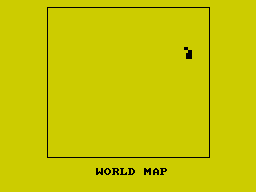
Dark Empire uses a top-down view that shows only a small section of the planet at once. Units appear as icons rather than detailed soldiers or vehicles, and unexplored land remains hidden until you reach it. That makes the map feel more like a compact war board than a scenic alien world.
The city and unit icons put function first. You are looking at positions, territory, and orders, with the current number of held cities and turns kept on screen to support the strategic view.

Story
The story is a lean conquest setup: you and your army have taken a city on a distant planet and intend to expand from there. It is enough to frame the conflict without getting in the way of the strategy.
That sparse premise works because the game’s drama comes from position. A city is both your base and the source of future strength, so the fiction of building an empire is tied directly to what you do each turn. Taking ground is not a side activity; it is the whole point.
Do not come expecting a character-led science-fiction tale. Dark Empire treats its alien planet as a battlefield to uncover and dominate. For this kind of old-school strategy game, that blunt focus is fitting: the narrative momentum is the map gradually becoming yours.
Overall Experience
Dark Empire has a clean, severe kind of strategy appeal. It gives you one city, a partially hidden world, and a small set of meaningful orders, then asks whether you can expand without losing control of the situation. The lack of clutter is its best quality. You can quickly understand what matters, even as the consequences of each turn become harder to manage.
Its age is most noticeable in the joystick cursor control and bare iconography. You need to be comfortable with a game that makes you work through its map one selection at a time. Still, that friction is easier to accept when you enjoy deliberate, turn-based planning rather than constant stimulation.
Give Dark Empire a chance if the idea of planetary conquest through careful unit placement, production, and exploration sounds satisfying. It is a focused war game rather than an elaborate one, but its one-city-to-empire structure gives every expansion decision a useful sense of purpose.



Reviews
There are no reviews yet.