 Retro Replay Retro Gaming History, Reviews & Emulation
Retro Replay Review
Gameplay
Kalah gets its hooks into you through consequences. Every turn begins with one simple choice: empty one of your six houses and distribute those seeds clockwise, one at a time. Yet the number of seeds in that house determines exactly where your move ends, so a harmless-looking scoop can hand your opponent a capture or set up your own extra turn. You can understand the rules almost immediately; seeing two turns ahead takes longer.
The key rule is also the most enjoyable one. Land the last seed in your store and you move again, which turns turn order into something you actively manipulate rather than passively accept. A well-planned chain feels great, especially when it lets you collect seeds, rearrange your side, and deny an obvious reply before the other player gets back in. That tension is why such a stripped-down board stays engaging.
Captures add the sharper edge. Ending in one of your empty houses can pull the seeds from the opposite house into your store, but only if that opposing house holds seeds. That makes the board a constant argument between building a productive sowing route and leaving no exposed target. Beginners may lose a big pile through a move they did not notice was dangerous, but that sting is part of the lesson rather than random bad luck.
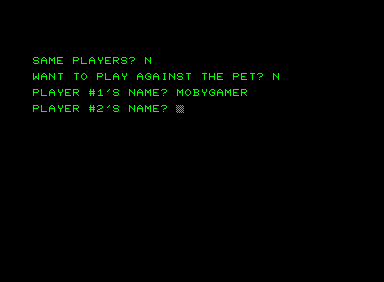
You can set the starting seed count, play another person, or take on the computer. Against another person, Kalah is at its strongest: pauses and hesitant house selections become part of the contest, and you get to enjoy spotting a trap before it is sprung. The computer option gives the game useful solo value, though the central pleasure remains this compact back-and-forth of planning, counting, and second-guessing.
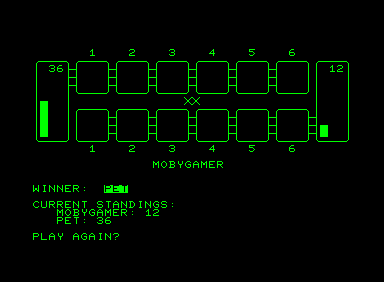
Graphics
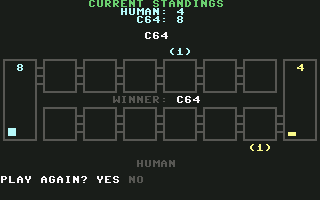
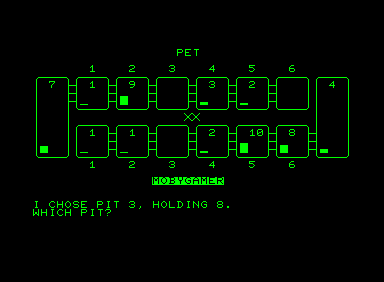
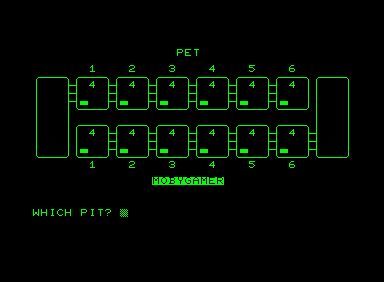
The game is built around a top-down, fixed board layout: two opposing rows of six houses, with a store for each side. That direct arrangement suits Kalah well, since you need to count seeds and judge where a move will finish without fighting the screen.
Story
Kalah does not need a written tale to create momentum. Each match writes its own small story through the changing seed counts: an early attempt to build an extra turn, a sudden capture across the board, then the tightening race as one side runs out of legal moves.
Your store total is the clearest measure of how that story is going, but it can be misleading in the middle of a game. A player who appears behind can still be arranging a long sowing path or baiting an empty-house capture. That uncertainty gives even a quiet match a satisfying sense of reversal.
The ending has real bite because the game stops when one player cannot move. You are not simply trying to take every attractive move; you are managing the shape of your houses so the finish arrives on terms that favor your store. For an abstract board game, that is enough drama.
Overall Experience
This is a lean, thoughtful Kalah conversion whose staying power comes from the board game itself. There is no wasted complexity between you and the decision that matters: which house to choose now, where the final seed will land, and what that leaves for the other side.
Give it a chance if you like games that reward counting and positional foresight more than quick reflexes. The first few matches can feel punishing because a single overlooked landing space can cost a large capture, but the rules are transparent enough that losses usually teach you exactly what to watch next time.
Its payoff is modest but genuine. Kalah will not occupy you with spectacle; it earns repeat sessions when you want a concise tactical duel or a solo board puzzle that becomes more interesting once the extra turns and capture threats start clicking. For that particular mood, it remains a sturdy choice.



Reviews
There are no reviews yet.