 Retro Replay Retro Gaming History, Reviews & Emulation
Retro Replay Review
Gameplay
The first thing you feel in Blitzkrieg is the clock. You are commanding German forces across Western Europe during a fixed May-to-September 1940 window, but the game does not wait politely for alternating turns. Orders play out in real time while the computer runs the European side, so there is immediate pressure to decide where your armies should go and whether a push is worth the time it consumes.
That real-time approach is the game’s strongest differentiator. Old-school wargames often invite you to settle in, place every order, and then watch a turn resolve; Blitzkrieg asks for more active attention. If you enjoy being forced to make broad operational decisions without the safety net of a turn-by-turn reset, its pace has real bite. If you prefer to study every move at leisure, the same structure can feel demanding rather than exciting.
Your objective is direct: take cities, force countries to surrender by capturing all of their cities, and accumulate 100,000 victory points. The point target adds a useful wrinkle to the conquest plan. England can be enough for victory even if France has not fallen, which encourages you to think about the quickest profitable route instead of treating every country as an automatic box to tick.
The limits are equally clear. This is a map-level war game about issuing orders to different force and unit types, not a broad historical sandbox. Success rests on managing a compact campaign and pursuing its scoring logic under time pressure. Give it a chance if that concentrated challenge sounds appealing; skip it if you want a more relaxed, turn-based sweep through World War II.
Graphics
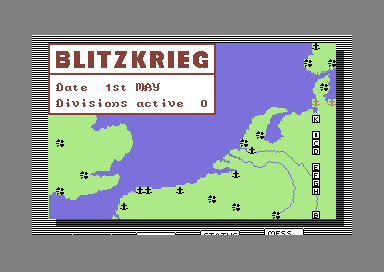
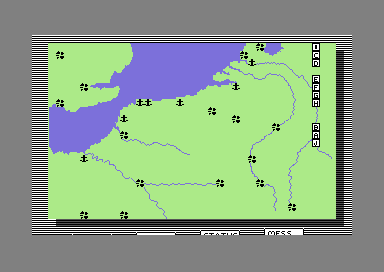
The screen centers on a top-down map of Western Europe, using icons to mark cities, armies, and terrain. It is a functional Commodore 64 battlefield view: you are reading the board and tracking movement across the map rather than admiring detailed soldiers or elaborate battle scenes.
Story
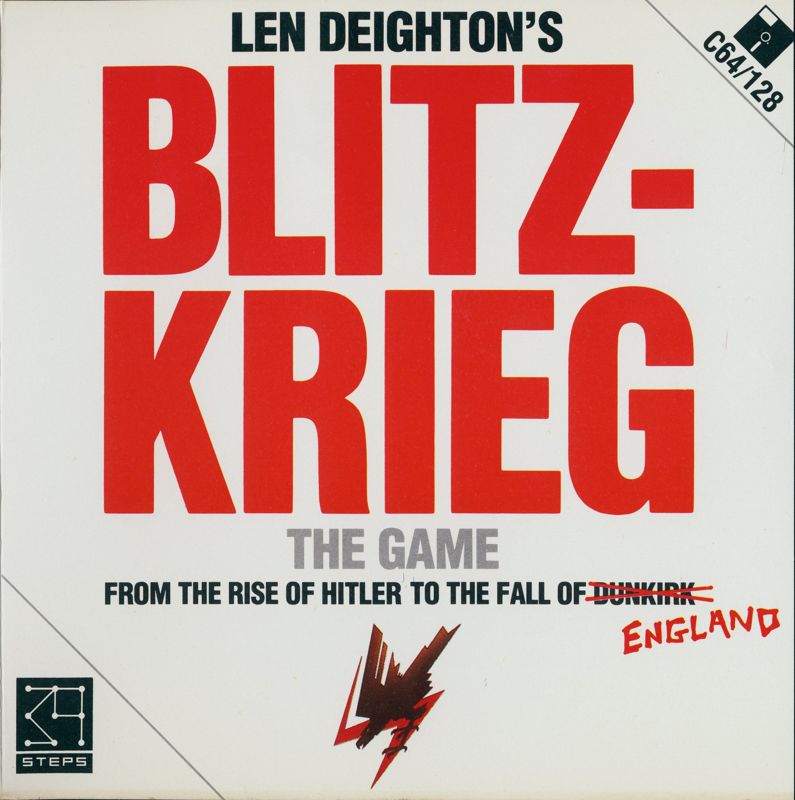
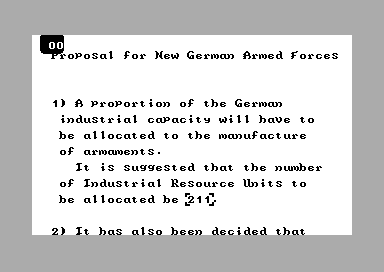
Blitzkrieg draws its framework from Len Deighton’s history book Blitzkrieg: From the Rise of Hitler to the Fall of Dunkirk, but its story is carried through the campaign premise rather than through named characters or dramatic scenes. You take control of German forces in the 1940 western campaign and pursue domination of Western Europe and England.
That makes history here a strategic frame, not a narrative reward. The dates, countries, and drive toward cities give your decisions context, yet the game’s focus remains firmly on whether you can turn territorial gains into surrender and points before time runs out.
The England objective also pushes the scenario beyond a straightforward retelling of the book’s Dunkirk-era subject matter. It gives the game an alternate-outcome edge: you are not merely retracing a historical timeline, but trying to force a winning conclusion on the map.
Overall Experience
Blitzkrieg is most interesting as an early attempt to make a large-scale WWII map campaign feel urgent instead of procedural. The real-time format gives its simple strategic vocabulary tension, and the fixed campaign period keeps the goal from sprawling into an endless conquest exercise.
Its victory rules are likely to divide you. On one hand, 100,000 points and the possibility of winning through England create room for a focused plan. On the other, a score-driven outcome can feel at odds with the otherwise sweeping historical subject, especially if you expect every major country to matter equally.
For a Commodore 64 strategy game, it is a worthwhile curiosity with a genuinely distinctive pacing idea. Wargame fans who can enjoy an austere icon-based map and the pressure of real-time orders may find a tense little campaign beneath the dated surface. Everyone else may admire the concept more than the experience.
Reviews
There are no reviews yet.