 Retro Replay Retro Gaming History, Reviews & Emulation
Retro Replay Review
Gameplay
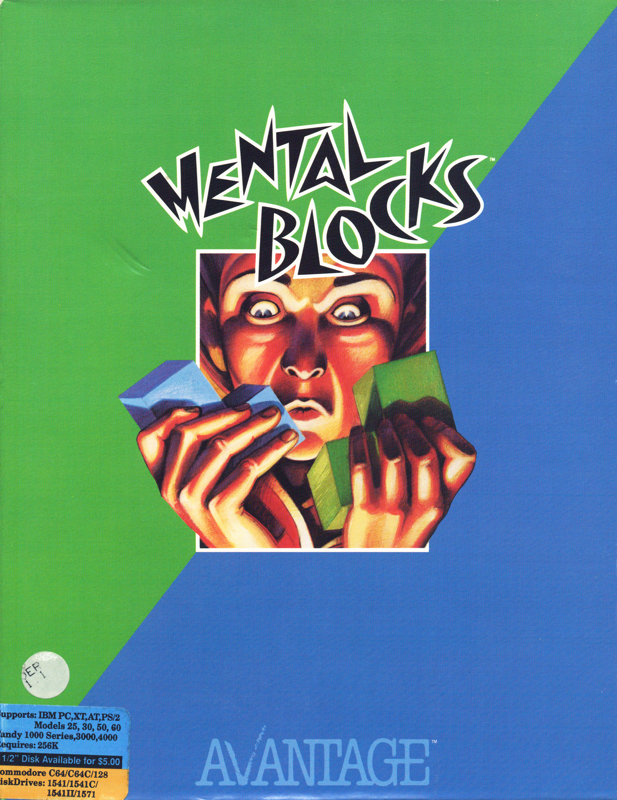
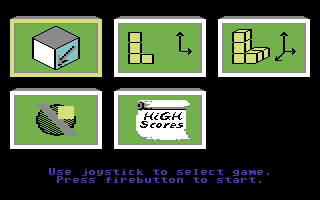
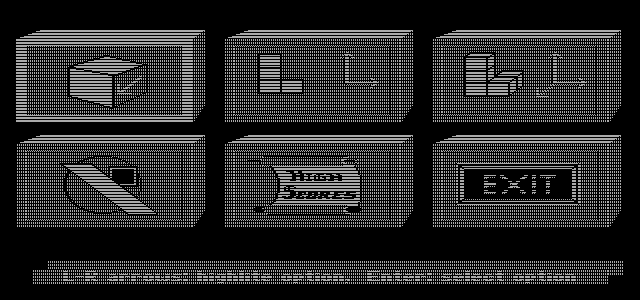
Mental Blocks approaches action and strategy through three compact brainteasers. Each game asks for a different kind of quick thinking: spatial placement in Free Fall, mental rotation in The California Achievement Cubes, and pattern recognition in What’s Next, Pussycat?. The variety gives the compilation a broader appeal than a single puzzle mode could manage.
Free Fall, also known as Fits and Pieces, is the strongest premise. It adapts falling-block play into three dimensions, making the goal the completion of an entire layer instead of a horizontal line. That one change makes planning more demanding, since a useful placement must contribute to a solid surface rather than merely fill a visible gap.
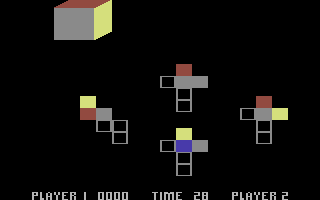
The two quiz-style games are more direct. The California Achievement Cubes, also called Mental Detector, asks you to identify which unfolded cube corresponds to the cube shown, while What’s Next, Pussycat?, also called Shapes Happen, asks you to continue a visual sequence. Both offer a timer for solo play and a race-to-answer format for two players, keeping the emphasis on speed as well as correctness.
Graphics
The game’s visual identity is rooted in clear geometric problems rather than decorative spectacle. Cubes, unfolded cube layouts, falling pieces, and shape sequences need to be readable at a glance, because the central challenge depends on recognizing their structure before time or an opponent gets ahead.
Free Fall has the most visually distinctive setup through its 3D puzzle space. The three-dimensional format is not simply a cosmetic variation on block stacking; it is the basis of the game’s layer-building objective and gives the player more spatial information to process.
The remaining games necessarily present information in a more test-like fashion: one cube against several possible nets, or a sequence against four possible continuations. This practical presentation suits the design. Players looking for lavish audiovisual display will find a modest package, but the geometry is the point.

Story
There is no narrative campaign tying the three games together. Mental Blocks is a compilation unified by mental challenges, not characters, plot progression, or a fictional setting.
That absence works in the game’s favor because every mode can begin with its central question immediately. Build a layer, rotate a cube in your head, or determine the next shape; the objectives are self-contained and easy to understand without narrative framing.
The playful alternate titles give the collection some personality, but they do not create a story. Players seeking an adventure or a sustained sense of world-building should look elsewhere; this is designed as a sequence of abstract tests of perception and reasoning.
Overall Experience
Mental Blocks is best suited to players who enjoy compact puzzle challenges and to pairs looking for simple competitive mental games. The solo timers add pressure, while the two-player options turn correct answers into a race, making the collection more social than a purely solitary logic title.
The compilation’s chief strength is its range within a focused theme. The layer-building of Free Fall asks for ongoing spatial management, while the cube and sequence games concentrate on quick recognition. Switching among them can prevent the experience from becoming too repetitive.
Its limitations are equally clear: the game is built from abstract puzzles rather than deep progression or narrative reward. Even so, the designs are easy to grasp and naturally replayable for anyone who enjoys improving at visual reasoning under pressure. Free Fall provides the most substantial variation, and the two competitive brainteasers round out a concise, thoughtful package.


Reviews
There are no reviews yet.