 Retro Replay Retro Gaming History, Reviews & Emulation
Retro Replay Review
Gameplay
Morpheus drops you into its rhythm quickly: prepare your ship at base, launch into an Aither, find the Orbitals, and destroy enough of them to shut down the central Nucleus. Each Aither is a compact objective-driven combat space rather than a long journey through deep space, and that gives the action a purposeful, repeatable momentum. You are always pushing toward the same immediate goal, but the 50 sub-universes give that goal a lot of room to last.
The radar is central to the experience. Since it marks the Orbitals and Nucleus, it turns free movement in every direction into a hunt rather than aimless drifting. Early on, you will likely spend time learning how to read the map and position the ship efficiently. Once that clicks, clearing an Aither becomes much more satisfying: you are routing targets, managing danger, and driving toward the Nucleus instead of simply shooting at whatever happens to be nearby.
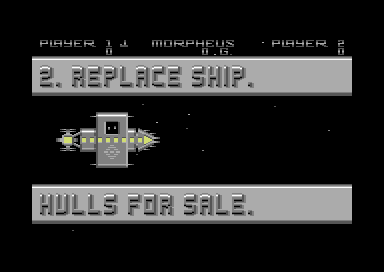
The strongest idea is the outfitting screen between deployments. Hulls and weapons are not just rewards handed to you; you purchase them with money, and can sell or scrap equipment that no longer suits your plans. That makes each return to base matter. You have a reason to think about what your next launch needs, and the growing scale of your ship provides a tangible sense that your campaign is advancing.
There is also a nice little punctuation mark at the end of an Aither. Destroying the Nucleus releases a Morphi, and taking that down earns bonus points and money. It is a clean incentive to finish the job decisively rather than treating the Nucleus as the only thing worth shooting.
Graphics
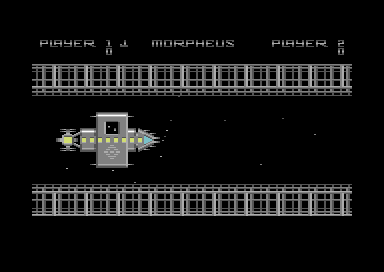
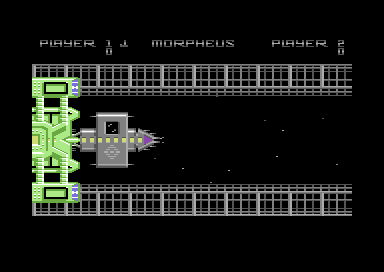
Morpheus uses an overhead view centered on your ship, with the score and a small radar sharing the screen. The radar is the most useful visual element because it keeps the Orbitals and Nucleus in view even when they are elsewhere in the Aither.
As you invest in hulls and weapons, your ship can grow until it nearly fills the screen. That is a memorable bit of visual progression: later-game hardware does not stay an abstract inventory entry, but visibly changes the scale of the craft you are piloting.
Story
This is a sci-fi mission framework rather than a narrative-led adventure. You travel through Aithers, each built around a Nucleus and its surrounding Orbitals, with the broad aim of dismantling these hostile sub-universes one by one.
The named pieces give the game a slightly unusual vocabulary—Aithers, Orbitals, Nuclei, and Morphi—but Morpheus is more interested in what you do with them than in explaining a sweeping plot. The stakes are delivered through the work: enter, destroy, collect the reward, improve the ship, and move deeper in.
That sparse approach fits the game’s structure. You are not waiting for the next story revelation; you are chasing the next successful deployment and the equipment purchase it can fund.
Overall Experience
Morpheus earns its 7.2 because it combines immediate top-down shooting with a progression system that gives the action a longer-term pull. The first hour is about understanding the Aither loop and relying on the radar. Later, the question becomes how you want to shape a much larger, better-equipped ship.
Its repetition is also its dividing line. Every mission returns to the same basic task of removing Orbitals and killing the Nucleus, so you need to enjoy refining that process rather than expect a constantly changing set of objectives. The buying, selling, and scrapping layer does useful work here, because it makes repeated deployments feel connected instead of disposable.
Give it a chance if you like old-school space shooters that let you earn your way into stronger hardware, and if the idea of systematically clearing 50 combat zones sounds more inviting than overwhelming. Morpheus is not complicated in its moment-to-moment goal, but it has enough structure around that goal to make persistence pay off.



Reviews
There are no reviews yet.