 Retro Replay Retro Gaming History, Reviews & Emulation
Retro Replay Review
Gameplay
The first stretch of Nippon is driven by the pleasant uncertainty of a real expedition. Toshiro has been thrown from a magic scroll into a feudal Japan with monsters and magic at its edges, and you are left to move across the overhead map and start making sense of it. Villages are not just stops for buying stronger gear; they are places to question peasants, hunt for useful information, and work out what deserves your attention next. If you enjoy early RPGs because they let you wander first and explain themselves later, this has a genuine pull.
Conversation is where the game separates itself from a routine monster crawl. You cannot simply exhaust dialogue: Toshiro needs to use the right tone, whether that means being subservient or intimidating, to get somewhere with a peasant. That is a neat idea because it turns talking into part of the puzzle-solving rather than a quick interruption between fights. It can also be where frustration starts. A wrong approach does not feel like a twitch-skill problem you can immediately correct; it asks you to read the situation, reconsider your approach, and be willing to experiment.
Combat is compact and positional. Once a fight starts, the current screen is locked down, and you must move into place beside an enemy before attacking. Winning earns experience, which eventually improves strength, agility, and hitpoints, so battling has a clear long-term purpose without displacing exploration as the center of the game. Routes carry their own hazards too: teleports can alter how you travel, while fire paths are passable but cost health. Add the need to eat and sleep, and even a short trip asks you to think ahead.
That mix makes Nippon more methodical than immediately comfortable. You will get more from it if you like mapping out a world in your head, checking villages thoroughly, and treating setbacks as information. Anyone hoping for rapid battles or a heavily guided quest may find the pace stubborn, but the game’s systems do start to connect: supplies matter because travel is risky, character growth matters because fights have stakes, and conversation matters because discovery is progress.
Graphics
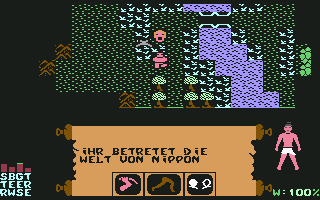
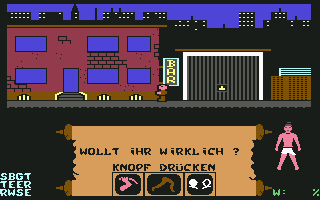
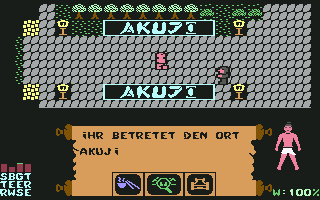
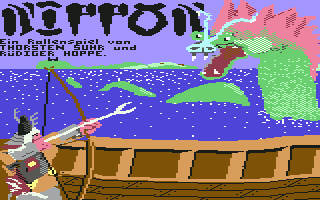
Nippon shifts between an overhead scrolling world map and separate village or battle screens. That change gives towns a distinct place to search for NPCs and makes battles feel contained rather than like random bumps on the road. The mix of top-down travel and side-view elements is very much in keeping with an era when a game’s world was assembled from compact, screen-by-screen spaces.
Story
The setup is lean but effective: Toshiro reads a magic scroll and is teleported into a version of feudal Japan where monsters and further scroll magic exist alongside villages and peasants. It is a strong excuse to make the unfamiliar country itself the subject of your attention. You are not handed a sprawling dramatic hook so much as a reason to start asking questions and following leads.
The story works best as a frame for investigation. Each village conversation can feel potentially useful because the right manner of speaking matters, and the fantasy elements give the landscape room for stranger routes and dangers than a purely historical setting would allow. That puts the emphasis on your own gradual understanding of the world rather than on constant scripted revelations.
Do not come to Nippon expecting character drama to carry the experience. Its narrative strength is atmosphere through activity: traveling, seeking people out, choosing how to address them, and piecing together a path through a foreign land. For a game built around exploration and puzzles, that is the right priority, even if it makes the story feel spare by modern RPG standards.
Overall Experience
Nippon is the kind of RPG that asks you to meet it halfway. Its best moments come from noticing that a village might hold more than a shop, that a different conversational posture could unlock a response, or that an inconvenient route may be useful despite the damage it causes. Those small deductions create a satisfying sense that you are navigating a place rather than clearing a checklist.
The rougher side is inseparable from that old-school commitment. Managing hunger and sleep alongside health, gear, and progression can turn a simple outing into a careful calculation, while puzzle progress may demand persistence. Yet that pressure gives the journey weight; Toshiro is not merely passing through a map, and you cannot treat every discovery as free.
Give it a chance if you have patience for late-1980s computer RPGs and want exploration to matter as much as leveling. The payoff is not flashy action but the steady satisfaction of learning how its world works. Nippon remains a niche recommendation, but for the right kind of curious, methodical player, its blend of travel, social guesswork, and practical survival has more character than its simple combat first suggests.


Reviews
There are no reviews yet.