 Retro Replay Retro Gaming History, Reviews & Emulation
Retro Replay Review
Gameplay
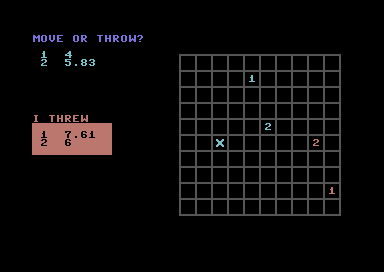
Piegram gets interesting almost immediately because a thrown pie is never merely an attack. If it misses, the number attached to that pie’s location tells you how far away the target was when you threw it. At first you are simply probing the grid and hoping for a useful number; soon, you are comparing several results, narrowing down possible squares, and deciding whether to move before the computer pins you down.
The three-pie limit is the key source of pressure. You cannot leisurely build a huge archive of clues, since only the last three pie locations remain visible. That forces you to read the board in the moment and make each throw do double duty: it should help locate the AI while avoiding a move so obvious that it helps the AI predict you in return. A tiny ruleset produces a pleasingly sharp contest of deduction.
The AI’s ability to triangulate once it has three pieces of data keeps the game from becoming a relaxed logic puzzle. You are racing the same conclusion it is racing toward, and movement matters because your position can change before a calculation becomes lethal. Expect some frustration while learning to translate distances into likely locations, especially when a turn feels like it has handed the computer exactly what it needs. That danger is also what gives successful reads their punch.
This is a narrow game, but intentionally so. If you want tactical variety, long-term progression, or a forgiving pace, Piegram will feel bare. If the idea of a brisk grid duel built around spatial reasoning sounds satisfying, its clean back-and-forth can hold your attention far longer than its modest setup suggests.
Graphics
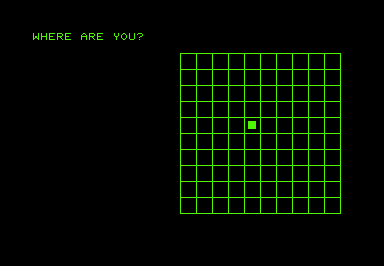
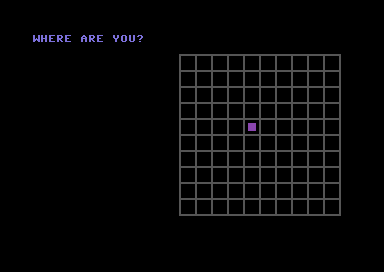
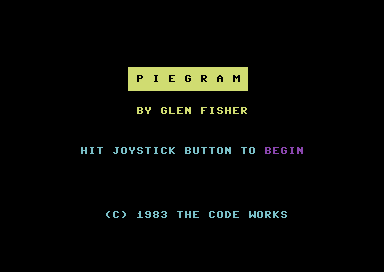
The action is viewed from above on a fixed grid, with pie locations and their numbered distance clues displayed directly on the board. That straightforward layout suits a game where the important thing is comparing squares and numbers rather than admiring decoration.
Story
Piegram does not lean on a written plot to create momentum. The conflict is immediate: find the AI before it calculates your position and lands a pie on your square.
Instead, each match creates its own small story of false leads, risky moves, and a final deduction. A throw that initially looks useless can become the clue that reveals the answer after the next pie lands.
That stripped-down approach fits the game. You are not here to meet characters or chase narrative twists; you are here for the satisfying moment when scattered distances suddenly point to one tile.
Overall Experience
Piegram is a clever, compact strategy duel with a stronger mind-game than its premise initially suggests. The first few turns teach the basics quickly, but the real hook arrives when you realize every clue you gain is also a clue the AI may be using against you.
Its age shows less in the rules than in the scale: this is one focused idea rather than a broad package. That makes it easy to recommend in short sessions, especially if you enjoy pencil-and-paper-style deduction translated into turn-based play.
Give it a chance if you like working through spatial puzzles under pressure and can enjoy repetition in pursuit of better reads. Skip it if you need lavish visuals or a changing series of objectives. For the right mood, outthinking the computer with the same three clues it has feels wonderfully fair—and wonderfully tense.



Reviews
There are no reviews yet.