 Retro Replay Retro Gaming History, Reviews & Emulation
Retro Replay Review
Gameplay
Stop! gets interesting the moment you have made a little progress and decide it is not enough. Every turn begins with four dice and the chance to build sums from pairs, but the real game is deciding when to quit. You can lock in your advances by stopping, or throw again in pursuit of a stronger turn. A bad roll that cannot advance one of your active markers ends the round and wipes out everything you had not made permanent. That is a clean rule, and it creates the kind of pressure that makes a tiny board game hard to put down.
The three-marker limit is where the tactics start to click. Early on, you can place markers in columns supported by the dice, but once all three are in play, future rolls must help those same columns. Suddenly, choosing a tempting total is not just about immediate movement; it is a commitment that can trap you on the next throw. Doubled sums add a satisfying wrinkle, since finding two different dice pairs that make the same total lets one marker move twice. You are constantly weighing the odds, the remaining distance, and the danger of having nowhere legal to go.
The uneven column sizes are a smart piece of board design. Common totals have farther to travel, while rarer results get shorter routes, so chasing a column is never as straightforward as it first looks. Winning three columns means you need a plan broader than one lucky climb. Against the computer opponent, that makes each secured column feel valuable rather than routine.
Frustration is built into the bargain. A turn can collapse after several excellent rolls, and the game will punish greed with no sympathy. But that sting is also why a cautious stop feels clever and why a reckless successful push produces real relief. If you dislike dice deciding whether a good plan survives, Stop! may feel cruel. If you enjoy push-your-luck games where your own decision to roll again is the source of the disaster, it has lasting bite.

Graphics
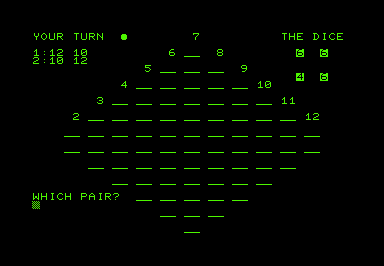
The board is centered on eleven numbered columns, covering totals from two through twelve, with markers climbing toward their tops. That straightforward layout suits a game where you need to judge column length and track three active markers at a glance.

Story
Stop! is a contest, not a narrative adventure. Its drama comes from the state of the board: a marker nearing the top, a rival column already claimed, and a roll that could either rescue a turn or erase it.
That lack of story is a strength for this kind of game. Nothing interrupts the core exchange of calculation, chance, and nerve, so a match gets moving quickly and stays focused on the next decision.
You still create a small personal tale in every close game. It is the tale of the column you stubbornly chased, the safe progress you banked, and the throw you knew was risky before you made it.
Overall Experience
Stop! is a compact tactical dice game that understands exactly where its tension lives. The rules do not take long to learn, yet the interaction between dice pairs, three temporary markers, unequal columns, and the choice to stop gives you plenty to think about. The first hour is likely to include both an overly conservative turn and an avoidable bust; after that, the risk decisions become much sharper.
Its strongest moments arrive when the obvious move is not necessarily the sensible one. A short column may look inviting, but committing a marker there can make your next roll awkward. A long, common-number column seems slow, yet it may offer more ways to keep a turn alive. Stop! asks you to make those judgments repeatedly without burying them under complicated rules.
This is worth playing if you want an old-school board-game challenge that makes probability feel immediate. The computer opponent gives the race a purpose, while the permanent-versus-temporary progress system keeps every turn taut. There is no cushion for bad luck or overconfidence, but the payoff is a brisk, brainy game where stopping at the right time feels every bit as satisfying as a fortunate roll.



Reviews
There are no reviews yet.