 Retro Replay Retro Replay gaming reviews, news, emulation, geek stuff and more!
Retro Replay Review
Gameplay
Stratton starts with a good bit of urgency. A bombed shuttle has crashed into the Stratton Air Terminal, the station’s moorings and life support are gone, and its defence systems have trapped the survivors inside. You enter in a buggy, armed with lasers, and the top-down view puts the whole mission in practical terms: steer through the maze, fire when needed, and try to bring order back to a terminal that has gone badly wrong.
The central task is more involving than simply surviving the maze. You must rescue survivors and deactivate the Central Computer, but the lost entrance code means the shutdown has to be forced by removing every breaker and then the final databus. That gives the action a clear end goal and makes each stretch of exploration matter. You are not just driving around looking for another target; you are working through a station-wide emergency one component at a time.
The trade-off is that this is deliberately direct, old-school fare. Movement is handled with the joystick and firing with a single button, so the challenge rests on navigation, timing, and keeping track of what still needs to be done. Frustration can set in if a multidirectional maze leaves you disoriented, especially when the larger shutdown sequence depends on finding all of its required parts. Gamers who like being handed constant guidance may find that starkness tiring; anyone who enjoys mapping a problem in their head may find it the point.
Graphics
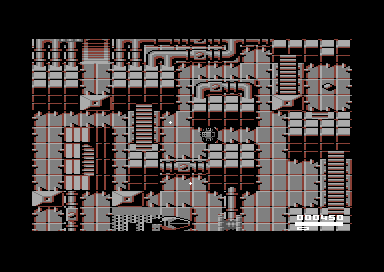
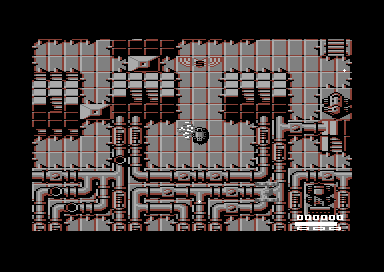
Stratton uses an above-view maze perspective centered on your buggy and the terminal corridors around it. That viewpoint suits the game’s immediate concerns: you can see the route ahead, guide the vehicle through the station, and follow the compact shooter action without fighting the camera.
Story
The setup has the brisk, high-stakes shape of a science-fiction rescue story. Terrorists destroy a shuttle, the wreckage damages the terminal, life support fails, and the automated defence units turn the disaster into a lockdown. It is a strong reason to send you in alone, and it gets to the crisis without wasting time.
What makes the premise work is the way the mission objectives follow the disaster. Survivors need extracting, the base needs securing, and the Central Computer has to be taken offline because it controls the computerized and mechanical systems. The missing entrance code is a small but useful complication, turning a straightforward shutdown into a scavenging job across the terminal.
Do not come to Stratton expecting a character-heavy space drama. Its story is a mission briefing, not a sprawling narrative, but it gives the maze and its dangers a welcome sense of consequence. Every breaker removed pushes you closer to making the station safe rather than merely reaching an arbitrary finish.
Overall Experience
Stratton is at its strongest when you accept its compact mission on its own terms. You are in a buggy inside a crippled space terminal, shooting your way through active defences while trying to locate survivors and dismantle the system that has locked everyone in. That is a clean, immediately understandable loop with a satisfying final objective: remove the last databus and end the emergency.
Its age shows in the stripped-back structure. The controls are minimal, the maze is the main source of resistance, and the game asks you to supply patience and a sense of direction. There is little room here for a player who wants elaborate storytelling or constant changes of pace, but the uncomplicated design also means you understand the stakes from the moment you take control.
Give Stratton a chance if you have a fondness for 1980s Commodore 64 action games that make a single location and a clear assignment carry the whole experience. The rescue angle and multi-step computer shutdown lift it above a completely aimless top-down shooter. It is a modest game, but one with enough tension in its terminal disaster scenario to reward a focused session.


Reviews
There are no reviews yet.